9 Days of Rustic Kyushu, Day 4 (Part 4) : Samurai Houses + Dejima

Sunday, 12 March 2017


Day 4: Kazusa Dolphin Watching Cruise --> Unzen Jigoku Hell --> Shimabara Spring Group (Carp Streets) --> Shimabara Castle --> Samurai Houses (武家屋敷) --> Dejima (出島) --> Hotel

Once we were done at the Shimabara Castle, our guide drove us a short distance away to the Samurai Houses of Shimabara. The area is also known to the locals as Teppo-machi or "Gun Town". It is where the samurais of the past used to reside. Now, these old samurai houses have been preserved and restored, and are open to the public free of charge.


Unfortunately, I found these houses to be creepy. They've put up life-sized mannequins to mimic the lifestyles of the old samurai families, but honestly, these were just creepy. Like the one in the picture above, just peeking through a hole, as if any moment, it would disappear and re-appear beside you.
 
*too much Hollywood shows*


Anyway, there were 3 samurai houses that we could have visited. We popped into 2 and decided that it was enough for the day. My parents were tired and I really didn't like the mannequins on display.
 
Needless to say, we were out of there pretty quick.
 
Tip:
If this is something that rocks your boat, then I would suggest that you put the following 3 attractions together as they are really within very close proximity to one another. It would save you quite a bit on the travelling time.
Shimabara Castle, the Carp street and the samurai houses.


My guide then decided that we could still make it to see Dejima (出島), which was a small fan-shaped island built by the local merchants. Dejima was originally built to house the Portuguese traders but later became a Dutch trading post. Serious isolationlist policy Japan had back then. Today, Dejima is no longer an island as the surrounding land has also been reclaimed.
 
By the time we arrived at Dejima, we were cutting it a little close to the closing time. Hence, there was very little human traffic. By then, mom was also really tired but managed to put up a good sport and trudged through portions of Dejima. Good thing about the place, there are a lot of sitting spots. Mom would constantly find herself one of those many spots to rest while dad and I climbed the buildings to explore.


The Dejima now is more like a museum exhibit of (again) life back then in Japan as a foreign merchant. A lot of the exhibits pertained to the lifestyle (yes, again) of the people back then. What was interesting though, was that some of the exhibits were designed to be a little more interactive. At least, mom enjoyed herself more in Dejima than at the samurai houses.
 
Even then, after a couple of houses, you'll realise that most of the structures were similar. And after a while, we also lost interest in the exhibits. I mean, yes there's much to read and look, but there's only so much of our attention span to be had. And non-interactive exhibits (which was majority) isn't really the best way to hold one's interest.


There is also a scaled model of Dejima. However, it's all the way to the end and you'll have to trudge through a semi-grassy patch. Well, actually, it's not the grassy patch that's of issue, but that there were a lot of mosquitoes, flying insects and cobwebs around. And that's my biggest phobia: insects, especially of the flying variety. Yet I wanted at least 1 picture of the model. Once that was done, I was out of there pronto.
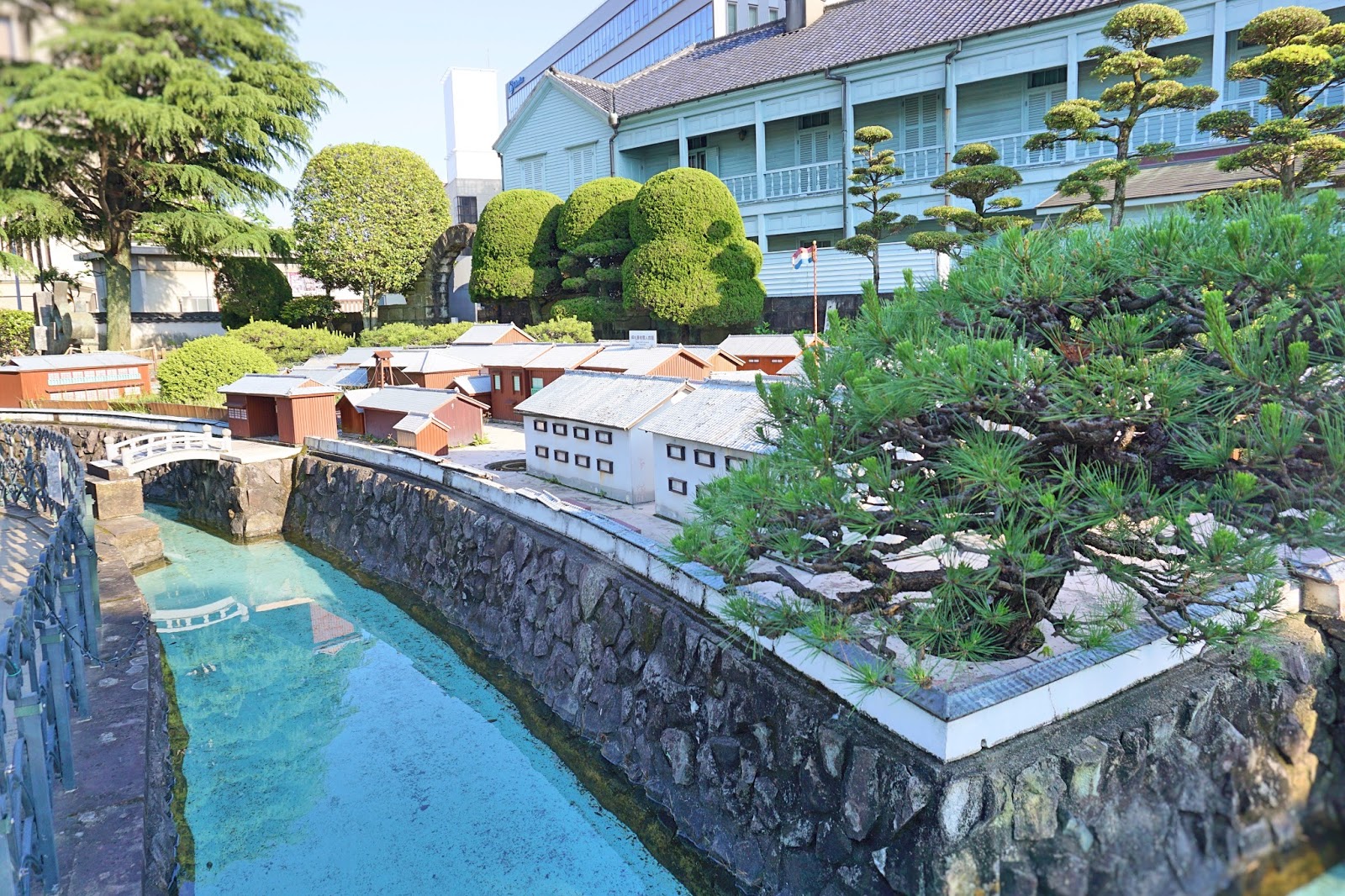


One of my biggest learning point of that day: Do not pack the itinerary if travelling with my parents. While my parents are still pretty mobile, they do tire easily. Particularly my mom, who does have some difficulty with her knees.
 
Day 4 was unfortunately, pretty packed with quite a bit of walking. Hence, before we were even done at Dejima (and we didn't spend a lot of time there), mom was asking for dinner to be served. So off we went to Chinatown for some grub.
 
Nagasaki's Chinatown is apparently one of the 3 Chinatowns in Japan, the other 2 being Chukagai in Yokohama and Nankinmachi in Kobe. Nagasaki's Shinchi (新地中華街) is the smallest of the 3 Chinatowns though. Like most Chinatowns, you can find medicine shops and shops selling Chinese wares, especially food. What's interesting though is apparently, this place also sells the Japanese version of the Chinese mooncakes! 
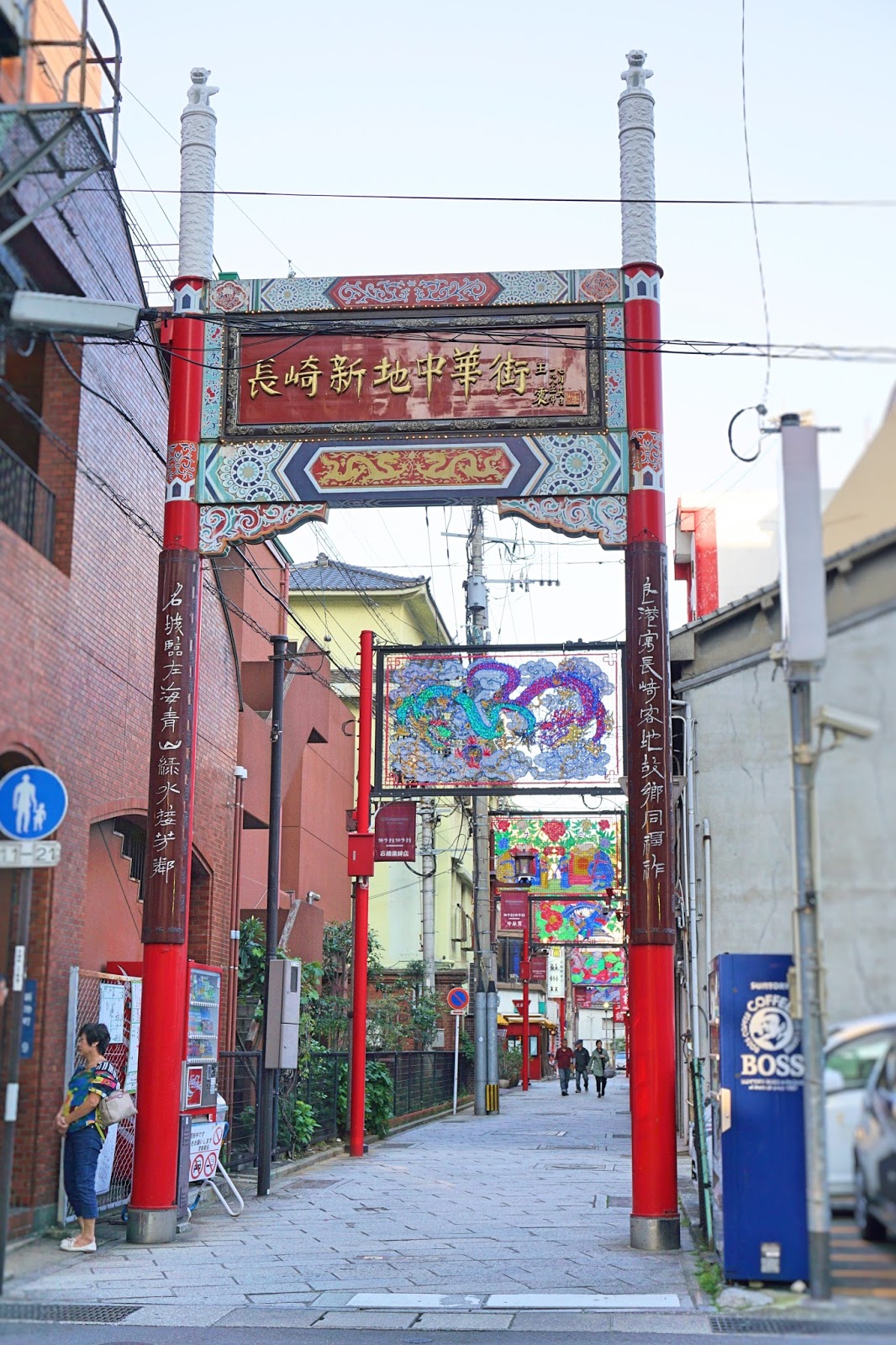


Unfortunately for us, apparently, Nagasaki's Chinatown becomes a deserted street when it comes to evenings. Most of the shops were already closed. So there was nothing much really to see. In addition, most of the restaurants appeared to serve similar things. So, we just went with one of the restaurants that was featured in my guide book: Sosyuurin.


The food wasn't too bad but we all agreed that our lunch the day before at Horaiken Bekkan was the best of all the Chinese-Japanese meals we had in Nagasaki. Plus, the service staff at Sosyuurin felt more like the ones we have back here in Singapore! None of the enthusiastic Japanese hospitality at all! Perhaps an indication of the place really being too touristy.


We also happened to chance on some really awesome looking sweets in one of the shops after our dinner. And they were so amazing crafted! I probably took the picture at a wrong angle but that's a persimmon and an apricot that these sweets were supposed to resemble. Mom and I decided to buy to try as they really looked too pretty!
 
Unfortunately, it looked prettier than it tasted. Mom said next time to just take pictures and not bother.  Heh. She sounded as if we could definitely come back again.
 
Nagasaki Shinchi Chinatown marked the end of our day 4 and the end of our stint in Nagasaki. By then, we were so whipped, it was back to the Crowne Plaza ANA Nagasaki Gloverhill for a much needed rest.
 
 
Tourist Information
 
Tip: To combine Shimabara Castle, Carp street and samurai houses on the itinerary
 
Samurai Houses
Address: Shitanocho, Shimabara 855-0052
Local Address: 〒855-0052下の丁山本邸、篠塚邸、鳥田邸
DID: +81 957-63-1087
Admission is free
 
Dejima
Address: 6-1 Dejimamachi, Nagasaki 850-0862
Local Address:  〒850-0862出島町6-1
DID: +81 95-821-7200
 
Nagasaki Shinchi Chinatown
Address: 12-7 Shinchimachi, Nagasaki 850-0842
Local Address: 〒850-0842新地町
 
Sosyuurin
Located within Nagasaki Shinchi Chinatown
DID: +81 95-823-0778


9 Days of Rustic Kyushu, Day 4 (Part 3): Shimabara Castle

Sunday, 5 March 2017


Day 4: Kazusa Dolphin Watching Cruise --> Unzen Jigoku Hell --> Shimabara Spring Group (Carp Streets) --> Shimabara Castle (島原城) --> Samurai Houses --> Dejima --> Hotel

The carp streets of Shimabara lie south of Shimabara Castle and merely a short distance away. Hence it was not long before we had to hop off our car again to tour Shimabara Castle.


Shimabara Castle is a reconstructed 5-storey feudal castle with a huge outer moat. Apparently, the castle was far larger than normal for a feudal lord; his income didn't pay for the construction of the castle. Instead, it was heavy taxation that paid for the original castle. This was apparently a major factor that led to a rebellion in Shimabara.
 
The original castle was however subsequently destroyed. The reconstructed castle was eventually competed in 1964, after the people of Shimabara requested for its restoration.


Upon arriving at Shimabara Castle, we were greeted by a couple of actors dressed up as feudal lords. As it was already mid-afternoon, most of the tour groups would already have completed this destination on their itinerary. Otherwise, there would have been more of such actors around. Some would even put up a mini-show to entertain visitors.
 
These actors are also often obliging when it comes to taking photos. See how readily this dude posed when all I did was point my camera in his general direction! He even asked if my parents wanted a group shot together with him!
 
Oh and by the way, this was at no cost. I do know of some places where they would charge photos at a fee though.


Admission fee for Shimabara Castle was at 540 yen per adult. As usual, my mom backed out of climbing the 5-storeys hence it was only dad and me who went through the museum exhibits within the castle.
 
While doing my research prior the trip, I came to read about the persecution of Christians and Christianity in Japan. It was also apparently a factor that led to the uprising. When the original castle was destroyed, a collection of Christian artifects, weapons and armour were excavated from the ruins. These are now displayed within the 4-storey castle museum.


The top floor of the castle is the expected observatory deck with a view of Shimabara's cityscape, the nearby Mt Mayuyama. If the weather is good, you can even look across the seas to Kumamoto.
 
As you can see from the brochure, the castle grounds consist of other zones including 3 turrets which have been converted into various exhibits. Unfortunately, as my parents were tired by then, I only did a quick walk around the gardens and did not visit any of these other facilities. Even then, there were pretty good photo points. I got so caught up taking pictures, my parents had to hurry me.


Photo tip: If you want a good shot of the castle with an accompanying turret and moat, your best vantage point will be below the castle, before you even drive up the moat.
Unfortunately, I was in the car already on the way out. Since my parents were already tired, I didn't bother to stop.
 
 
Tourist Information


Shimabara Castle
Address: 〒855-0036 Nagasaki Prefecture, Shimabara, Jonai, 1 Chome−1183−1
Local Address:  〒855-0036城内一丁目1183-1
Website: http://www.shimabarajou.com/
Admission fees: Adult 540 yen, School kids 270 yen
Parking fees: Ordinary cars 320 yen, large bus 1,080 yen, small bus 540 yen
Opening hours: 9 am to 5:30 pm


9 Days of Rustic Kyushu, Day 4 (Part 2): Rokubee + Shimabara Carp Streets

Sunday, 26 February 2017


Day 4: Kazusa Dolphin Watching Cruise --> Unzen Jigoku Hell --> Shimabara Spring Group (Carp Streets) --> Shimabara Castle --> Samurai Houses --> Dejima --> Hotel
 
The next time, I should time-stamp my photos. I realised that I'm not exactly sure whether we stopped for lunch first or whether we went to the Unzen Jigoku Hell first. I have a tingling feeling that its the latter. And since I didn't mention lunch in the last post, it'll be in this one then.


Anyway, lunch on Day 4 was a recommendation by our guide: Rokubee (六兵衛). The specialty was a local noodle that was made from sweet potato flour mixed with grated yams. The dish was apparently named after a man called Rokube. It is believed that he had invented this dish to prevent the people in Shimabara from dying during a period of famine.


Rukobee is a small family-run establishment with bar and tatami seating. While the place couldn't sit many, we realised that their traffic flow was constant during the entire time we were there. People just kept popping in and out either to dine in or for takeaways.
 
Rokube itself is a very simple dish; noodles in a soy-based broth topped with chopped green onions and grated yam. The noodles themselves were an acquired taste. We all agreed that it was springy but while I enjoyed the taste, my parents didn't particularly like it. Nevertheless, we all drained the bowl of the hot broth which was a warm welcome to the tummy after a morning out in the brisk air.
 
The highlight however, was a hot bun that was made from the same sweet potato and yam flour. Now that one was seriously yummy! I would have happily swapped my bowl of noodles for that bun! Initially we only ordered one to try but the minute we all took a bite, we ordered a second one for the road!


Before proceeding to Shimabara Castle on our itinerary, our guide again recommended another pit-stop, the crap streets of Shimabara. Again, this was something that had initially caught my eye while planning for the itinerary. During planning, I had decided to skip it in fear that there would be too much walking and a lack of time. Hence, it was great when our guide assured us that while there would be some walking needed, it was well-worth it and only a quick pit-stop.
 
And boy, I'm glad we listened to him about this.


We started at the designated tour office. There's a mini-shop next to it, so you can stock up on drinks. Strongly recommend that you do so especially if you're visiting in the summer and in the afternoon. While you walk the streets, the sun will be beating down on you.
 
The real fun starts after you move out from the tour office and walk along the streets. The highlight of this area were the craps that could be found swimming in the area's drainage system! Yup you read that right! Carps in drains!
 
My parents and I were highly impressed by how clean the water was in the drains. They were even linked to some koi ponds in some houses. We were told that the residents took pride in their crap street and worked to maintain the area. Simply amazing! I cannot envision this kind of community pride happening anywhere in Singapore!


As assured by our guide, this was a pretty quick pit-stop. We took only about 30 to 45 minutes to marvel at the fishes before we were beaten back to the tour office by the hot mid-day sun.
 
I'll highly recommend this as part of a driving itinerary for sure. It's a quick stop with a lot of Instagram-worthy shots. Besides, I doubt there'll be many places where you can say that you've seen carps swimming in drains.
 
 
Tourist Information
 
Rokubee (六兵衛)
Address: 1-5916 Hagihara, Shimabara, Nagasaki Prefecture
Local Address: 萩原1-5916
DID: +81-957-62-2421
Operating Hours: 10:30 am to 11 pm, open on Sundays too.
 
Shimabara Spring Group (Carp street of Shimabara)
Address: Block 2, Shin-cho,Shimabara
Local Address: 〒855-0843 島原市新町二丁目
DID: +81-957-63-1111
Admisison is free, and parking available near the tour office


9 Days of Rustic Kyushu, Day 4 (Part 1): Dolphin Cruise + Unzen Jigoku Hell

Sunday, 19 February 2017


Day 4: Kazusa Dolphin Watching Cruise --> Unzen Jigoku Hell (雲仙地獄) --> Shimabara Spring Group --> Shimabara Castle --> Samurai Houses --> Dejima --> Hotel
 
Day 4 saw us taking a day trip out to Shimabara and our first stop was a dolphin watching cruise in Kazusa Town.

While we were there pretty early (at about 9 am), there was already a Japanese family ahead of us. We were first made to go through a briefing. Unfortunately, it was again done in Japanese and of not much use to us. Our guide did translate here and there, but I'm pretty sure there was much that he didn't really tell us.


What little bits I did get, was that dolphins were actually a pretty common sight in that part of Japan. However, sightings would depend sometimes on where the dolphins were headed for food. I'm also quite sure that the briefing included some basic biology of the dolphins. No way to mistake that when the lady pointed to their size and weight that was indicated on the board. Plus, there were hand gestures that mimicked the shape of the dolphins.
 
Sigh. Someone should really help them with getting some audio tape support.


That's the boat we took for the cruise! It looks kind of tiny after the ferry we took to Hashima Island but actually well-served its purpose. Besides, you wouldn't want too many people fighting with you to catch sight of the dolphins. This way, everyone on board was ensured that they would get to see the dolphins even when remaining seated.
 
Yup! We were warned not to lean too far out in our dolphin excitement and that it was best to remain seated. Despite the language barrier, the cruise operators were very strict on safety protocols. They made sure that our guide translated that portion of the briefing. They also ensured that we had our life vests on, and knew what to do with them before they allowed us to board the boat.


Our first indication that we were in luck.
 
Once we were out of the port, it was not long before we caught sight of our first dolphin! Once someone shouted and pointed it out, we could immediately see a whole shoal of them!
 
THE ENTIRE BOAT OF PEOPLE WENT GA-GA!
 
Seriously, I meant that. Of course, in the "OMG! Look at them! So cute!" way. Well, at least that's what I assumed the Japanese were saying. I'm pretty sure they said Kawaii a few times. But really, it was amazing seeing them so up close and in the wild.
 
We were not allowed to feed the dolphins, something which I completely agree with. The dolphins need to survive in the wild and human interference should really be kept minimal. But even without the lure of food, these lovely water creatures were not shy! Our boatman killed the engines the minute the dolphins were spotted, so we were just drifting. And these dolphins just swam really close to the boat; to the left, to the right, under the boat.
 
Even my mom, who was groaning at the thought of another boat trip (she's got motion sickness and is never without her pills on trips) got jubilant at seeing the dolphins. She actually clapped her hands like a kid who just got sweets.


By the way, that's a baby dolphin swimming with its mama!
OK. I assume mama but it could be papa for all I know...
 
Anyway, a word of caution. Please do put on some sunscreen and bring along water as well. I was too excited with the dolphins, too was occupied with taking photos and lulled by the strong sea breeze into thinking that everything was ok. I forgot all about the sun and hydrating myself until it was a little too late. Obviously, that didn't help my flu one bit but I swear, you'll forget all that during the dolphin cruise.


My departing shot of the lovely dolphins as we left to head back towards land.
I was really quite sad to end this part of the tour. It was really enjoyable even if we weren't allowed to do anything much. This was also one of my dad's favourite part of the tour.

On my original itinerary, once we were done with the dolphins, we were supposed to head to Shimabara Castle. However, our guide told us that we had plenty of time, and brought us to another attraction that was along the way: Unzen Jigoku Hell.


Unzen Jigoku is pretty famed for its onsen (hot spring) resorts. Similar to the Jigokudani Hell Valley that we visited in Hokkaido, this was a hotspot of volcanic activity. Basically, hot water, gases and white steam are abound. The sulphur stink here was also very strong. Unfortunately, my mom couldn't take it and we left the place within 30 minutes. It was a good thing that admission was free!


Although I did not get to explore much of the place, Unzen Jigoku Hell was also a nature park. There are trails that lead to the woods and to various onsen resorts.

Interestingly, Unzen Jigoku Hell was also a site where Christians were martyred during the period where they were persecuted in Japan. They were tortured in the boiling waters and many did not make it out alive. I cannot imagine the pain they would have gone through, just take a look at the video of the boiling water there. Hell was definitely a apt name for the place.


Tourist Information

Kazusa Dolphin Watching
Address: 251-11 Otsu, Kazusa-cho, Minamishimabara 859-2605, Nagasaki Prefecture
Local address: 〒859-2605加津佐町乙251-11 
DID: +81 957-87-4640

Unzen Jigoku Hell
Address: Obamacho Unzen, Unzen 854-0621, Nagasaki Prefecture
Local Address: 〒854-0621小浜町雲仙
Website: http://unzen.org/tourism/spot1.html
Admission: Free


FREE BLOGGER TEMPLATE BY DESIGNER BLOGS