Showing posts with label Driving Tour. Show all posts

9 Days of Rustic Kyushu, Day 6: Mameda-machi

Monday, 1 May 2017

In Japan, there are several places with the nickname of "Little Kyoto" simply because they convey the rustic charms of Kyoto. Mameda-machi is simply another one in Hita, a shopping street where the locals have tried their best to preserve old-world Japanese customs and architecture.
 
According to some Japanese websites, some of the wares sold here are also unique to the area. A decent pit-stop really if you are passing by the area.


Day 6: Mameda-machi (日田豆田町商店街) --> Beppu Hell Valley --> Yufuin Town --> Hotel
 
By day 6, we started moving towards Oita. Our first stop that morning was the famous shopping street of Mameda-machi. Except we probably got there a little too early. Many of the shops weren't even open yet!
 
So if Mameda-machi is a place you intend to visit, please make arrangements to get there after 11 am. The place felt so deserted at 9:30 am, we were done by 10 plus and decided to leave since there wasn't anything else open. A real pity since I had actually read so much about it online that it was a shopping street that I was looking forward to!

I had originally scheduled it later in the itinerary but because of some changes made, it was re-scheduled to this morning. That kind of irritated me since it obviously showed that our guide didn't do much to advise us.


However, if in the event that you happen to also be there at 9:30 am, you can pop into the Kuncho Sake Brewery and take a look at how local sake is brewed. The spring waters of Mameda-machi is also pretty famous and the brewery prides its good brew on the use of the spring waters.
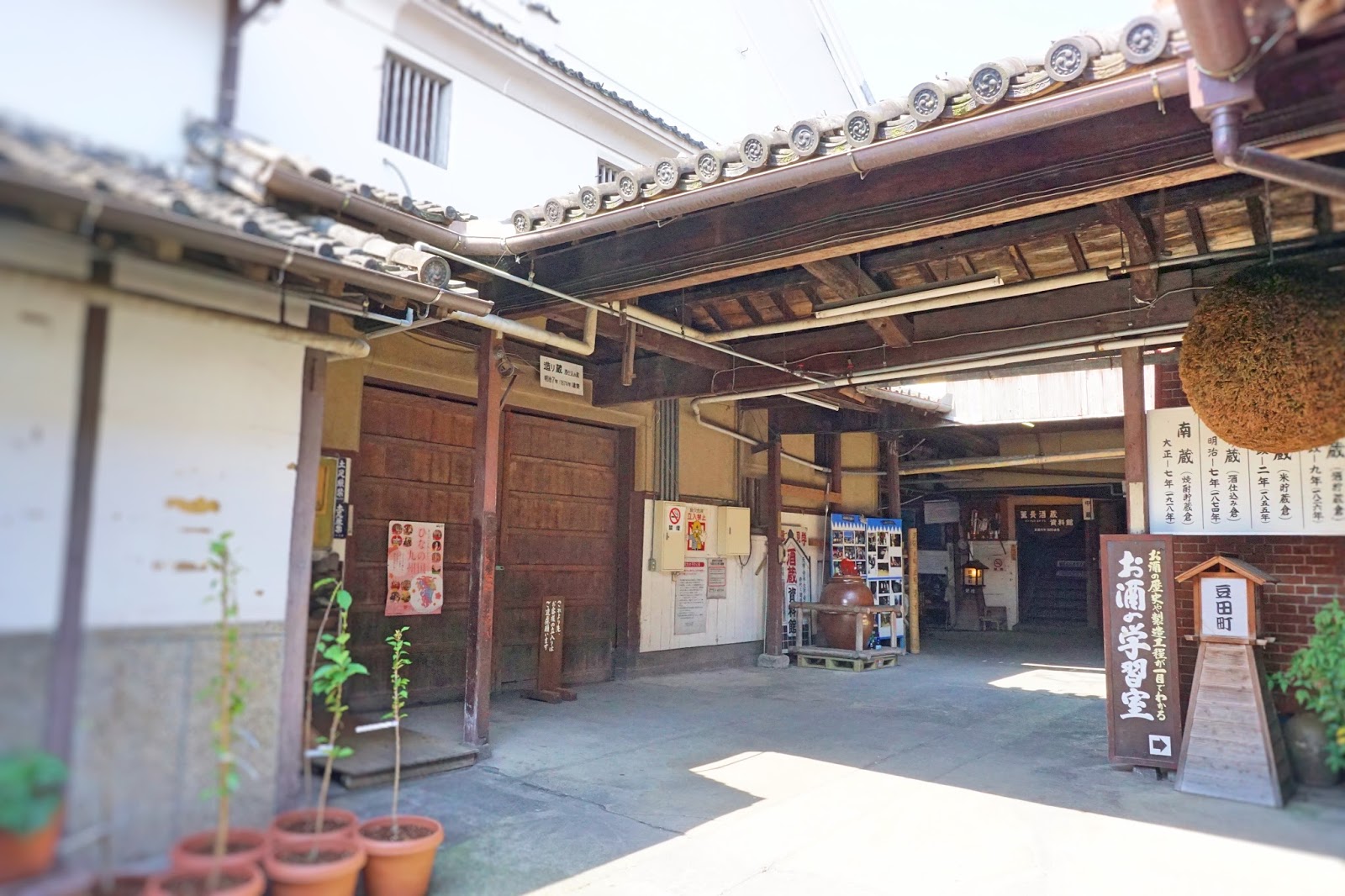


Sadly, my parents aren't sake drinkers so the beauty of the brewery was kind of lost on them. After a moment's consideration, I also decided not to buy any. We were running short on luggage space because my dad was being stubborn and had refused to bring his big luggage. He definitely heard from me and mom when we realised we were running out of space and had to budget our shopping.

Plus, my mom was also complaining that our liquor store at home was over-flowing.
Heh. She's always lamenting how she doesn't really understand how her children become drinkers when their parents both hardly do so.

Anyway, I digress.
At Mameda-machi, you should also look out for this little wooden shack where you can refill your water bottles with their famous spring water. All for a token sum that's up to you.
Mom was worried that it would give us tummy upset (typical worried mom's reaction) but I went ahead and had a taste of the water.


Oh by the way, apart from the Kuncho Sake Brewery, you should also make a visit to Hita Shoyu. Unfortunately, I forgot to take pictures of the place, but to be honest, it's really hard to miss that place. Hita Shoyu is the other famous store in Mameda-machi.  It was serious disappointment that it was only opening as we were leaving so I didn't have a chance to go in. Otherwise I would have loved to bring back a bottle of Japanese soy sauce!


We also stopped by this place (photo above) that was selling traditional Japanese sweets. Whenever I have a chance during my Japan trips, I'd love to visit at least one of these traditional sweet shops. Each region/place usually has their own unique sweets and sometimes even seasonal specialities.
 
A word of caution though. Don't over-buy as these traditional sweets tend to be (ahem) very sweet. 


The first time I had these traditional sweets years back was a memorable culinary disaster. Primarily because I had over-bought. Basically I thought to get one in every flavour to try. It was major sugar overdose and we just couldn't finish them. Since then, my parents and I just get 2 to 3 different flavours to try.


Mameda-machi is also pretty famous for their Hina dolls. If I'm not mistaken, there's a Hina Doll festival running if you were to visit in March.
 
These Hina dolls are actually a tradition and not for play. The dolls are often arranged in tiers with the prince and the princess dolls right at the top. These dolls are said to possess special spiritual powers. Should a doll become broken, they are not to be simply discarded away. Instead, a ritual is needed to dispose of the doll.
 
So, when you're there, please be mindful and respectful. It's best to just visually admire these Hina doll displays and not meddle with them thinking that these are toys.


We also dropped by this craft store that was open at that time. A lot of very well-crafted fabric dolls for sale. Some were downright adorable and would have looked good if I had display shelves at home!
 
 
Tourist Information
 
Mameda-machi
Address: Mamedamachi, Hita 〒877-0005, Oita Prefecture
Local Address: 〒877-0005豆田町


9 Days of Rustic Kyushu, Day 5 (Part 1): Yutoku Inari Shrine

Sunday, 19 March 2017


Day 5: Yutoku Inari Shrine (祐徳稲荷神社) --> Yangawa Canal Boat Ride --> Tosu Premium Outlet --> Hotel
 
Day 5 saw us winding down a little on the itinerary. I was pretty ill by day 5 and I could also tell that mom was exhausted from all the walking around yesterday.
 
The thing with bringing elderly parents around, is that you need to watch out for their physical activities and limitations. My dad's almost 70 years old and yet he's still raring to go most times. In fact, I'm the one who usually holds him back in fear of him exceeding his limits unconsciously. On the other hand, my mom's almost a decade younger than dad, but she's the one with all the leg, knees and walking difficulties. Mom actually needs help standing up after she's seated for a long time and all that.
 
So I had a little discussion with our driver-guide, and we decided to amend our itinerary to something a little more relaxing for my parents.


Hence, our first stop of the day, Yutoku Inari Shrine (back towards Saga). Our driver-guide assured me that mom would be able to deal with this one as part of their recent restoration, they had added a lift to their main structure!
 
Even then, mom was quite apprehensive when we first set eyes on the shrine from across the road. I don't blame her really. The place does look impressive! All that red that's set against the green mountains! It feels like the Kiyomizudera Temple in Kyoto all over. Even if there were no lifts and we couldn't climb, the view from below would have been well-worth a trip out!


The Yutoku Inari Shrine, affectionately known to the locals as Yutoku-san, is apparently considered to be one of the top three Inari shrines. Pretty easy to see why actually. The Inari is apparently one of Shinto's most popular deities and is associated with rice, prosperity and foxes.
 
The newly revamped side hall (photo below) is now air-conditioned and has lift access. I could hear my mom's sigh of relief when she finally caught sight of the lift. She was actually prepared to forgo and just wait inside the car for us. Well, the main and side halls stand on tall wooden beams 18 meters above the valley floor. If there were no lift, I would still climb, but it sure as hell would be done with a sigh of resignation.


For the fitness buffs, if you eschew technological conveniences such as the lift, stairs are plenty around for you to reach your goal too.
 
Do note though that the lift ride does cost a little. It also comes with a little good luck charm (photo below). So if you don't think you want to pay a little for a bit of convenience, stairs are always available.
 
I've got to say though. While we were there, there were many (and I do mean many!) elderly locals who were climbing the stairs up and down. Unaided and looking as if they weren't breaking any sweat over it! There were even a pair of grandparents (and I do mean grandparents with white hair and all!) jogging after their grandkids! Seriously! What's their secret?! Is that why people always say that the Japanese have longer life span?!
 
I was so completely ashamed of myself huffing and puffing up the trails that these seniors were bounding up and down on...


Anyway, the view once you get to the level of the main hall is pretty good. What was more amazing was that the place was done in such a way that it's quite wheelchair-friendly on that level! However, any further exploration would be limited. The rest of the walking trails are as called; a lot of walking and stair climbing needed.


Still, the main level provided for some architectural eye-candy. My mom got exasperated waiting for me to get my pictures of the gorgeous wall paintings and all.


The Yutoku Inari Shrine was really perfect for my parents. Dad was soon raring to go explore some of the trails. So I left my mom on the main hall level (she was so glad there was air-conditioning!) with our driver-guide and followed my dad for his morning-exercise of the day.
 
The walking trail leads from the main level further into the wooded hill. Sections along the trails were also covered by tori gates (according to our driver-guide, donated by persons and corporations for good luck and prosperity). There were also smaller shrines along the way that were dedicated to foxes.


To be honest, while I was huffing and puffing away, it really didn't feel like a pain walking that trail at all. Firstly, there were too many Instagram-worthy pictures to be had. It's just too bad my dad isn't the best model.
 
Secondly, I was also too busy trying to keep an eye out for dad. Do note that sections of the trail are paved with stones and some parts were wet the day we visited. Not the best combination; wet stone paths can get slippery-dangerous. I know since I fell a couple of times before on those. I didn't want dad to fall and I sure as hell didn't want to myself. Plus I was carrying my newish (then) expensive camera.


Dad and I spent some time climbing the trail until we reach a point where the paths were just stones (photo above). I refused to let dad climb further and we both headed back. Would have been interesting though to continue on just to see if the shrines also got more primitive further in.


For those of you who are interested in visiting the Yutoku Inari Shrine, do also note that there is a small traditional Japanese garden at the base of the hill. It was quite a tranquil place with flowing streams, low-arched bridges, sitting areas and lovely flowers in bloom. The garden is supposedly famed for its peonies blooms as well. Unfortunately, we missed the season. Instead, we saw some pretty azaleas instead.
 
However, there is an admission fee to the garden. I personally thought that it was quite small for the price we paid. So if you're not into the flower scene, you may want to consider skipping this altogether.


Do note also that there is a small snack stall open at the side of the entrance to the Yutoku Inari Shrine. My dad got himself a well-deserved matcha soft-serve which he happily declared to be one of the best after a morning climb.
 
 
Tourist Information
 
Yutoku Inari Shrine
Address: 1855 Furueda, Kashima 849-1321, Saga Prefecture
Local Address: 〒849-1321古枝乙1855
DID: +81 954-62-2151
No closing time
Admission to shrine is free
 
Shrine Garden
Admission fee: 200 yen
Opening hours: 9 am to 4:30 pm


9 Days of Rustic Kyushu, Day 4 (Part 4) : Samurai Houses + Dejima

Sunday, 12 March 2017


Day 4: Kazusa Dolphin Watching Cruise --> Unzen Jigoku Hell --> Shimabara Spring Group (Carp Streets) --> Shimabara Castle --> Samurai Houses (武家屋敷) --> Dejima (出島) --> Hotel

Once we were done at the Shimabara Castle, our guide drove us a short distance away to the Samurai Houses of Shimabara. The area is also known to the locals as Teppo-machi or "Gun Town". It is where the samurais of the past used to reside. Now, these old samurai houses have been preserved and restored, and are open to the public free of charge.


Unfortunately, I found these houses to be creepy. They've put up life-sized mannequins to mimic the lifestyles of the old samurai families, but honestly, these were just creepy. Like the one in the picture above, just peeking through a hole, as if any moment, it would disappear and re-appear beside you.
 
*too much Hollywood shows*


Anyway, there were 3 samurai houses that we could have visited. We popped into 2 and decided that it was enough for the day. My parents were tired and I really didn't like the mannequins on display.
 
Needless to say, we were out of there pretty quick.
 
Tip:
If this is something that rocks your boat, then I would suggest that you put the following 3 attractions together as they are really within very close proximity to one another. It would save you quite a bit on the travelling time.
Shimabara Castle, the Carp street and the samurai houses.


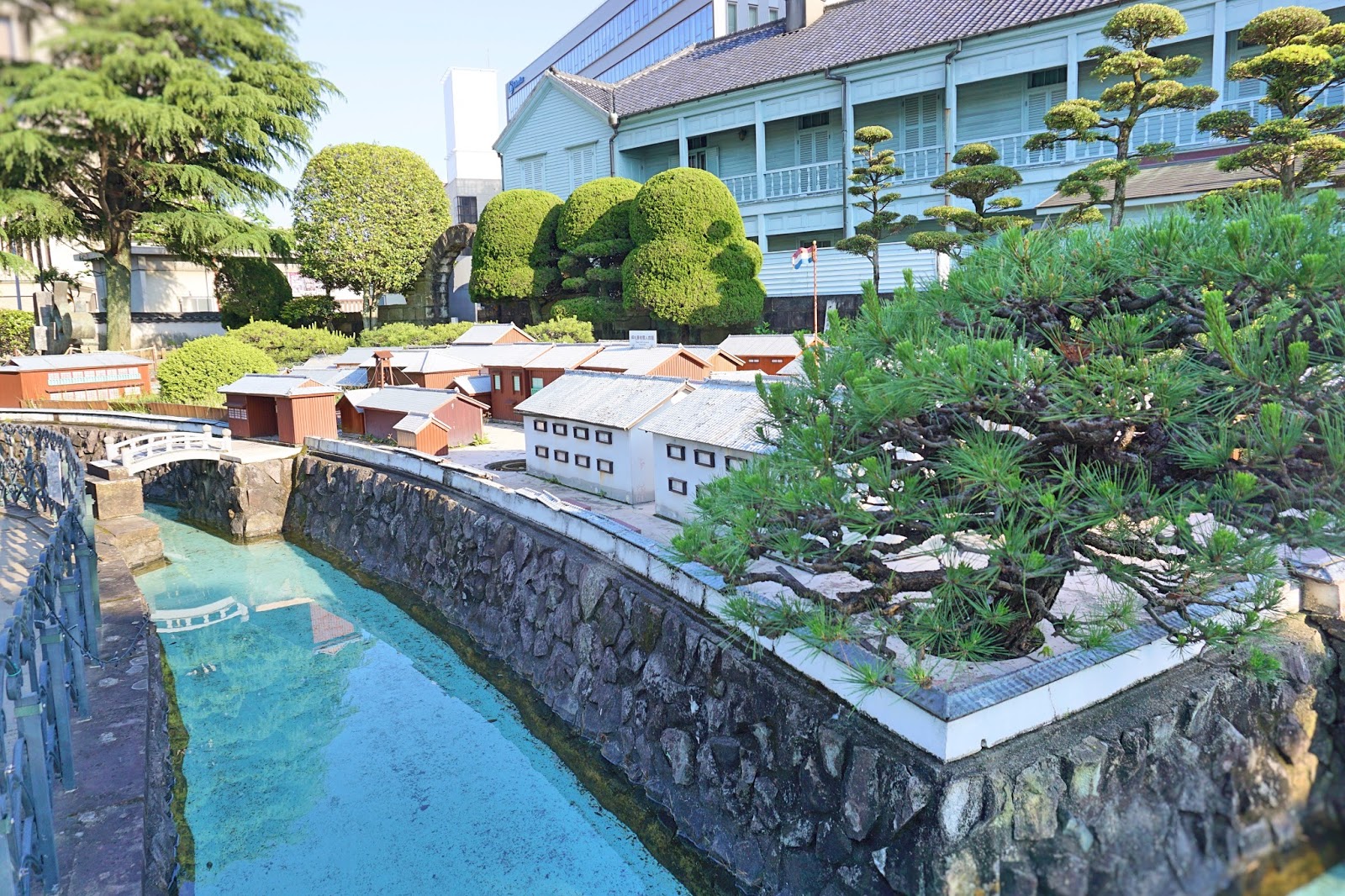
My guide then decided that we could still make it to see Dejima (出島), which was a small fan-shaped island built by the local merchants. Dejima was originally built to house the Portuguese traders but later became a Dutch trading post. Serious isolationlist policy Japan had back then. Today, Dejima is no longer an island as the surrounding land has also been reclaimed.
 
By the time we arrived at Dejima, we were cutting it a little close to the closing time. Hence, there was very little human traffic. By then, mom was also really tired but managed to put up a good sport and trudged through portions of Dejima. Good thing about the place, there are a lot of sitting spots. Mom would constantly find herself one of those many spots to rest while dad and I climbed the buildings to explore.


The Dejima now is more like a museum exhibit of (again) life back then in Japan as a foreign merchant. A lot of the exhibits pertained to the lifestyle (yes, again) of the people back then. What was interesting though, was that some of the exhibits were designed to be a little more interactive. At least, mom enjoyed herself more in Dejima than at the samurai houses.
 
Even then, after a couple of houses, you'll realise that most of the structures were similar. And after a while, we also lost interest in the exhibits. I mean, yes there's much to read and look, but there's only so much of our attention span to be had. And non-interactive exhibits (which was majority) isn't really the best way to hold one's interest.


There is also a scaled model of Dejima. However, it's all the way to the end and you'll have to trudge through a semi-grassy patch. Well, actually, it's not the grassy patch that's of issue, but that there were a lot of mosquitoes, flying insects and cobwebs around. And that's my biggest phobia: insects, especially of the flying variety. Yet I wanted at least 1 picture of the model. Once that was done, I was out of there pronto.


One of my biggest learning point of that day: Do not pack the itinerary if travelling with my parents. While my parents are still pretty mobile, they do tire easily. Particularly my mom, who does have some difficulty with her knees.
 
Day 4 was unfortunately, pretty packed with quite a bit of walking. Hence, before we were even done at Dejima (and we didn't spend a lot of time there), mom was asking for dinner to be served. So off we went to Chinatown for some grub.
 
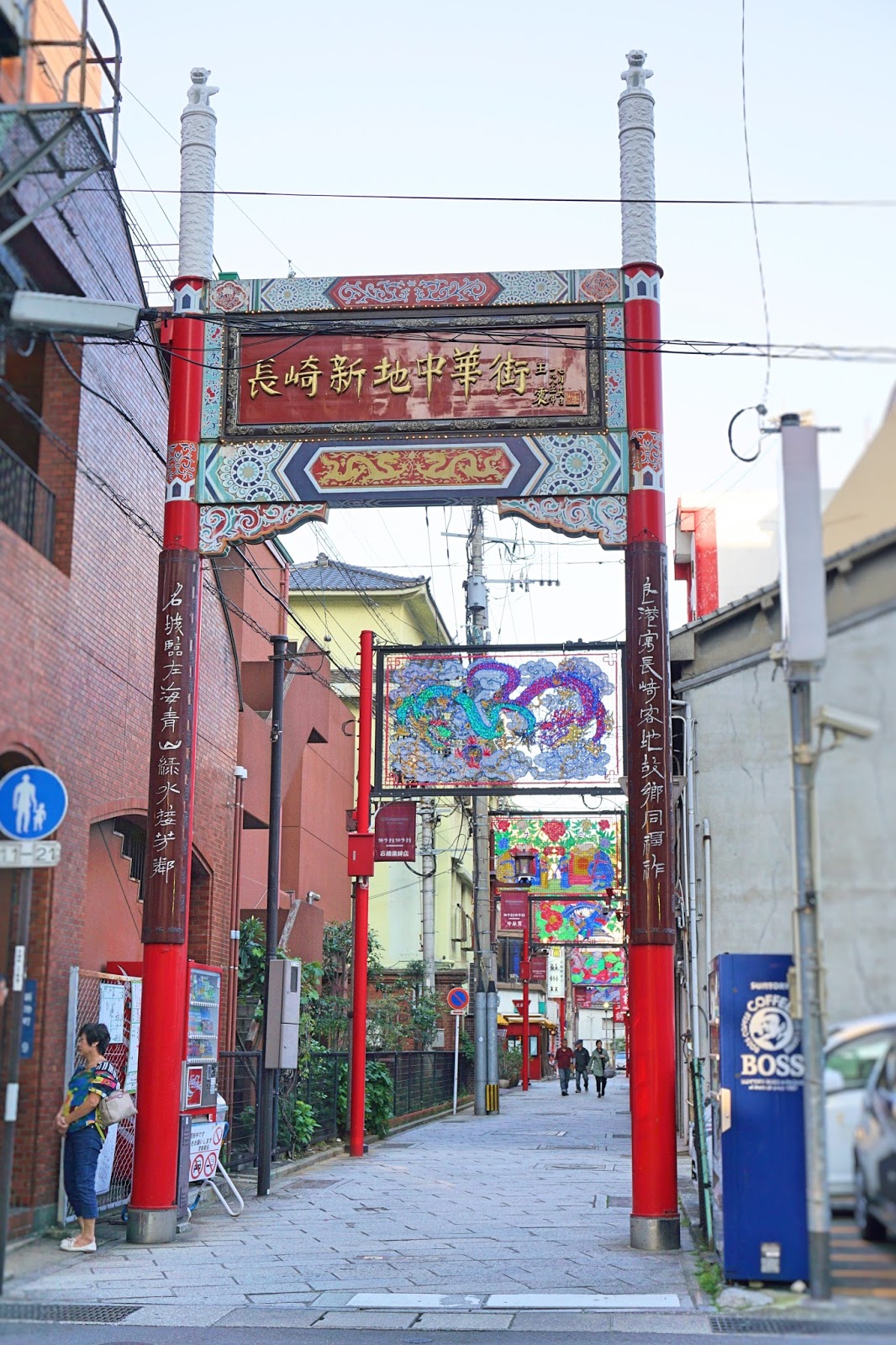
Nagasaki's Chinatown is apparently one of the 3 Chinatowns in Japan, the other 2 being Chukagai in Yokohama and Nankinmachi in Kobe. Nagasaki's Shinchi (新地中華街) is the smallest of the 3 Chinatowns though. Like most Chinatowns, you can find medicine shops and shops selling Chinese wares, especially food. What's interesting though is apparently, this place also sells the Japanese version of the Chinese mooncakes! 


Unfortunately for us, apparently, Nagasaki's Chinatown becomes a deserted street when it comes to evenings. Most of the shops were already closed. So there was nothing much really to see. In addition, most of the restaurants appeared to serve similar things. So, we just went with one of the restaurants that was featured in my guide book: Sosyuurin.


The food wasn't too bad but we all agreed that our lunch the day before at Horaiken Bekkan was the best of all the Chinese-Japanese meals we had in Nagasaki. Plus, the service staff at Sosyuurin felt more like the ones we have back here in Singapore! None of the enthusiastic Japanese hospitality at all! Perhaps an indication of the place really being too touristy.


We also happened to chance on some really awesome looking sweets in one of the shops after our dinner. And they were so amazing crafted! I probably took the picture at a wrong angle but that's a persimmon and an apricot that these sweets were supposed to resemble. Mom and I decided to buy to try as they really looked too pretty!
 
Unfortunately, it looked prettier than it tasted. Mom said next time to just take pictures and not bother.  Heh. She sounded as if we could definitely come back again.
 
Nagasaki Shinchi Chinatown marked the end of our day 4 and the end of our stint in Nagasaki. By then, we were so whipped, it was back to the Crowne Plaza ANA Nagasaki Gloverhill for a much needed rest.
 
 
Tourist Information
 
Tip: To combine Shimabara Castle, Carp street and samurai houses on the itinerary
 
Samurai Houses
Address: Shitanocho, Shimabara 855-0052
Local Address: 〒855-0052下の丁山本邸、篠塚邸、鳥田邸
DID: +81 957-63-1087
Admission is free
 
Dejima
Address: 6-1 Dejimamachi, Nagasaki 850-0862
Local Address:  〒850-0862出島町6-1
DID: +81 95-821-7200
 
Nagasaki Shinchi Chinatown
Address: 12-7 Shinchimachi, Nagasaki 850-0842
Local Address: 〒850-0842新地町
 
Sosyuurin
Located within Nagasaki Shinchi Chinatown
DID: +81 95-823-0778


FREE BLOGGER TEMPLATE BY DESIGNER BLOGS