Snacking in Japan, because Vacation Calories DON'T Count! (Now who am I kidding?)

Sunday, 5 June 2016

All right. I want to quickly finish this up so that I can get started on editing those Kyushu photos.
 
In the previous post, I had written about Pocky and Kit Kat, both of which are snacks that are enjoyed by many. Today, I'm going to write about other family favourites whenever me and/or my family visits Japan. And I'm going to start with another Japanese brand that is well-known and well-loved by many: Calbee.


For those uninitiated (which I don't believe there are many), Calbee is the brand that's famous for their potato chips and prawn crackers. Again, these are easily available in our local supermarkets, convenience stores, mama-shops, etc.

However, in Japan, you'll be mesmerized not just by the array of flavours available but also by the variety. Don't believe me? Just do a Google image search. Type in Calbee and the name of any Japanese region, and check out the images that pop up. They have everything from pumpkin chips to sweet potato chips, to flavoured potato sticks, and now even granola!
 
Again, remember to watch out for those key Chinese characters that I showed you in my previous post! Yup, you've got it! There are limited edition flavours when it comes to Calbee too!
So all those 期间限定 (time limited), 地区限定 (regional specialties) or 季限定 (seasonal specialties) that I had explained to you in the previous post is applicable here too! I remembered trying sakura flavoured chips when I visited in spring, choking on a regional wasabi specialty pack and hauling back onion chips which I thought was da bomb!
 
While my parents and I were in Kyushu this round for 9 days, everytime we popped into a convenience store, we'll leave with at least a packet of Calbee potato chips or prawn crackers. I think between me and my mom, we demonlished about 4 packets of prawn crackers and 3 packets of potato chips. That's quite a bit considering I was actually sick and should have been staying away from such snacks!
 
So if you're headed to Japan soon and you're a fan of potato chips and/or prawn crackers, make sure to pop into any of their supermarkets or convenience stores (Lawsons, Family Mart or 7-11) to check out the many flavours available.
 
Personally, I think Calbee products are also great as gifts, particularly those limited edition types. In my picture above (it's cropped to just highlight the Calbee), we bought home the mentaiko flavoured potato sticks (box on top) that's a regional specialty. While I love my mentaiko, I didn't particularly enjoy this one. The potato sticks are way harder than usual! However, my family and I loved the sweet potato chips (box in the bottom of picture). If I don't remember wrongly, there were only 6 small packs in the box and they were gone pretty quick over a couple of days. Because these are often individually packed, it's also easy to just distribute them out amongst family and friends.
 
By the way, Calbee also has boutique stores in Japan! If you're headed towards Tokyo or Hokkaido, please try to visit the Calbee boutique stores! Tokyo station, Harujuku station in Tokyo and the Chitose Airport in Hokkaido. Imagine fresh potato crisps (literally out of the fryer!) drizzled with your choice of toppings such as Royce chocolate or cheese and topped with a soft serve. It really doesn't get any better (or more decadent) than that!


Right, since soft serve is now mentioned, that'd flow nicely into the next recommendation I have for those of you visiting Japan: soft-serve, ice lollies and ice-cream. Eat all that you can!
 
Yup, this is another every-time-I-visit-Japan-must-eat item. There's just something that's simply amazingly yummy about the soft-serve in Japan. Maybe because they have an abundance of fresh milk? Or perhaps it's some secret ingredient or manufacturing process? Whichever, I usually find their soft-serve nicely creamy without the over-powering taste of milk.
 
But perhaps the most awesome thing is (again) the variety of flavours that's available! The soft-serve in my photo above is a pretty standard vanilla and grape mix. Yup, that's right. Grape flavoured soft-serve is considered mild. It's also one of the more common flavours around in Japan. Others in this mild/common category include strawberry, green tea, melon (which is absolutely delicious), milk, chocolate.
 
Now, if you're one of those who's up for exotic flavours or if you don't mind a culinary adventure, soft-serve flavours in Japan also come in unique ones such as miso, squid ink, asparagus, wasabi, tofu, etc. It all depends on where you are at. Yeah, I've done all of the above that I've listed. Culinary exploration. Plus, I'm already there so why not? But let's just say I'll still prefer the safer of the exotic such as hoji-cha. Now that's a seriously awesome unique soft-serve. Try it if you ever spot one, especially if you like hoji-cha! I think I had it in Kyoto...


Soft-serves are probably the most common of the ice-cream family that you'll find in Japan. In fact, each time you step into a major tourist attraction spot, there will definitely be at least one stall selling them. I was seriously amused when even boating down a river-canal, we had the option of stopping for soft-serve at stalls set up along the canal!
 
What's less common but still equally yummy are ice-lollies or ice-sticks like the one in the picture above. I simply love the fruit-based ones. I think because Japan is an agricultural country, these lollies often use fresh fruit as their ingredients. Just pick whichever fruit is currently in season, and enjoy them the ice-cold way. Another flavour that I often enjoy are the ones that uses Calpis. What can I say, I'm just a major Calpis fan. It's a good thing that they're not as readily available in Singapore, otherwise I'm sure I'd have overdosed on them.


And if store bought ice-cream is your to-go-to, you'd be delighted to know that these are also pretty awesome. Once in a while, I'd pop into their convenience store to try their local Japanese store brands. So far, they've been decent. Still prefer my soft-serves though.
 
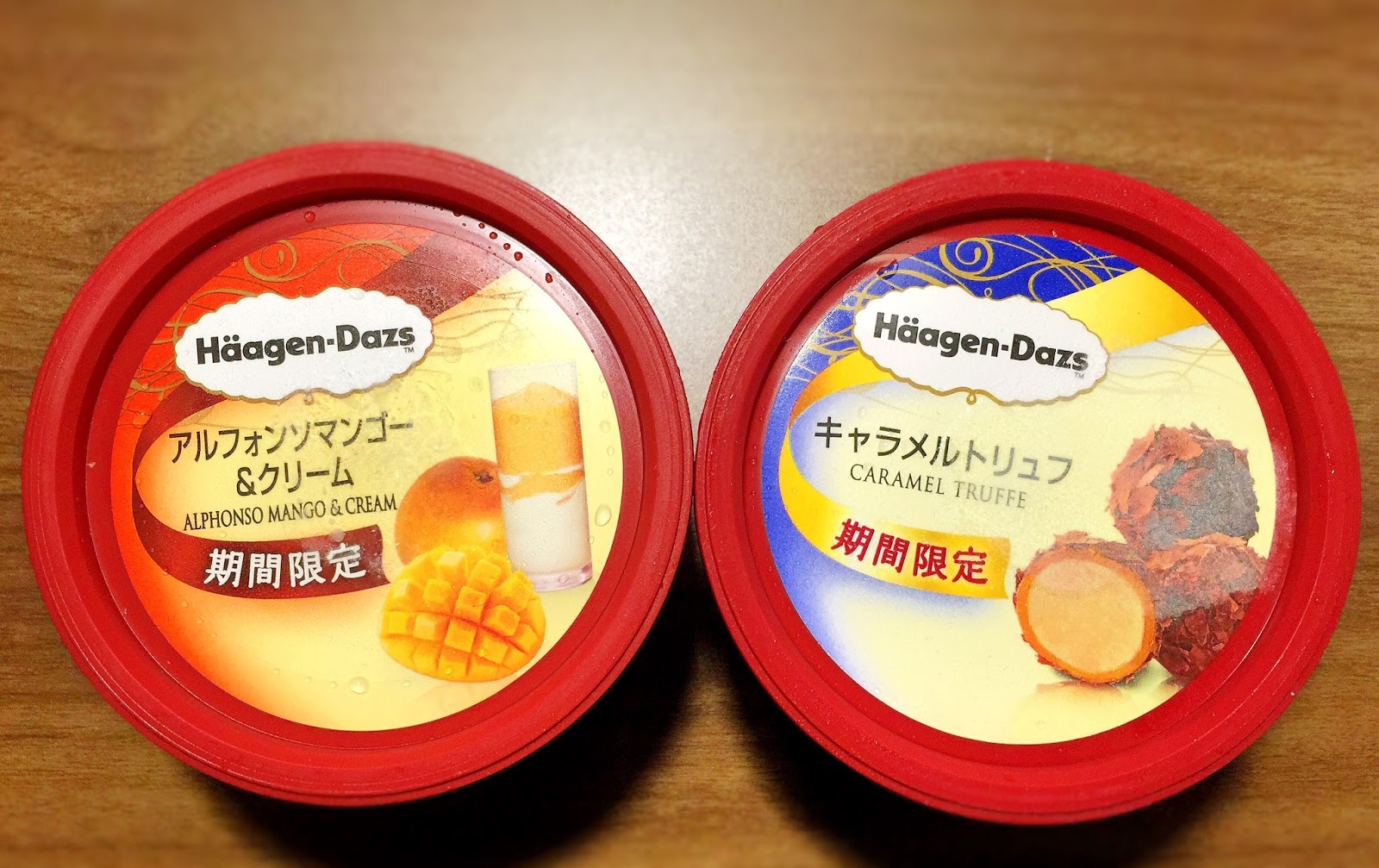
But if you're a Haagen Dazs fan, then it's a must to get to the convenience stores! You'd be delighted to know that Haagen Dazs comes in limited edition flavours too in Japan! What did I say before, Japan really is the land of limited edition flavours! Now can you spot the 4 Chinese characters in the picture by now?
 
The picture above features the Haagen Dazs that my dad and I tried this time round: Alphonso Mango and Cream, and Caramel Truffle. Both were pretty good. I got a photo of the Alphonso Mango and Cream one below. A wee bit melted as the hotel fridge isn't the most powerful of all fridges.


Now, the next item I'm going to write about is something I don't often read about in travel blogs or notes. Jelly cups, in particular, fruit-based jelly cups. These jelly cups are my mom's favourite and it's not difficult to understand why. Oftentimes, these cups are sweet. Not the overwhelming artificial sugar sweet kind of taste that you'd find in some. Instead, my mom likes that she can taste the fruit-like sweetness. Now, whether artificial sugar or fresh fruit sweetness, I'm not talking about the ingredients that's going into the cups here. What I'm saying instead, is that at the very least, they taste great and not like artificial sugar.
 
Like I mentioned earlier, these are my mom's favourite. Yes, she loves them even more than her beloved Pockys. Each time I bring her to a Japanese convenience store, that's the first stop she makes. It's not uncommon to see us hauling her bag of jellies (it's been a minimum of 3 cups each visit thus far) onto the car or bus.


While these are occasionally available in some of our local supermarkets like NTUC and Cold Storage, each palm-sized cup has been known to retail at anywhere between SGD$5 to $7. So while my mom loves them, it's her occasional indulgence if purchased in Singapore. In contrast, each cup we've bought in Japan is only between SGD$1 to $3. I guess that's why mom goes jelly-crazy in Japan.
 
Loquat was in season this time round when we visited Kyushu, so we bought home quite a number of loquat jelly cups for the mom (see picture above).


Since you read that I'm a major Calpis fan, it be remiss if I were to write such a post and say nothing at all about my favourite drink in Japan. Now Calpis (aka Calpico in some other countries since it apparently sounds like cow piss) is a sugary soft-drink that is reminiscent in taste of yogurt or Yakult. There's milk and lactic acid featured as ingredients so those of you who are allergic or intolerant, please be mindful.
 
Now, the common Calpis drink in Japan usually comes packaged in a plastic bottle with a blue and white label. You can google for that since I obviously didn't grab any pictures of the common one. Just be mindful that Calpis comes as Calpis soda or Calpis concentrate. Both packagings look pretty similar so please be careful that you don't buy the concentrate and start glugging it down.
 
In Japan, Calpis also comes in fruit flavours and that's often what I love looking out for. My picture above just portrays some samples from the collection of the flavours available. It's what I had this time round in Kyushu, with the lemon flavour one being a first-time trying it. That one tastes like yogurt mixed with lemonade - the refreshing sort. I quite enjoyed it.
 
These bottles of Calpis can be easily bought in supermarkets and convenience stores. Also, there are tons of vending machines around that can dispense these drinks. If you're headed to a pub or bar, you may also wish to try Calpis sour. That's a cocktail usually made from mixing shochu and Calpis concentrate. Some places will offer Calpis concentrate mixed with vodka or choya as well. Some restaurants offer this too, just check the drink menu. In some places, Calpis concentrate is also mixed with shaved ice for a refreshing dessert.


Now here's something that commonly written about. When in Japan, eat ramen!
 
Hahaha, of course you should! You're in ramen land! It's easily found everywhere, from ramen shops to stalls to the instant versions. Japan even holds ramen competitions and they're prestigious titles too! So it's really a big deal if a ramen store you patronise had won one of these competitions.
 
There are a few big-name ramen stores around in Japan. By that, I mean stores with established ramen reputation in ramen land. Some well-known ones include Ippudo, Ichiran, Santouka, etc. Picture above is a tonkatsu ramen bowl from Ichiran. We had the opportunity to visit its original store in Fukuoka this time round.


Friends of mine usually am well-aware of my instant noodle addiction. In fact, many times, my friends would travel overseas and bring me back instant noodles, particularly if its some unique flavour found in the country they've visited. Of course then, it's no surprise for me to feature instant noodles here. When in Japan with friends, we often buy back cup noodles to the hotels as snacks. (Yeah, not meals but snacks). Ok, for supper too. Basically, for those times when we suddenly feel hungry. And given how much we would have already snacked on in the day, that's quite amazing. With my parents around, I'm a lot more restrained since they've always nagged at my instant noodle intake.
 
Nissin is a favourite instant noodle brand of mine. Of course, I'll also get other brands to try but every trip, Nissin is a must. And please, likewise, don't just buy the ones you already often eat in Singapore. I love the cheese curry (in the picture above) and the chilli tomato flavour is pretty decent too. Nissin also has those awesome BIG cup noodles. Because how can 1 tiny cup fill you up? I just haven't gotten around to trying some other (in my opinion, weirder) cup noodles flavours such as milk seafood.
 
By the way, those famous big-name ramen stores that I mentioned 3 paragraphs above? Even they have decided to cash in on the instant ramen popularity. Yup, I've hauled instant bowls (well, they're nowhere near cup shapes) from Ippudo and Santouka back to Singapore before. In case you're wondering, yes, I'm one hell of a luggage-packer. I've never had an issue with crushed cups. My cup noodles have all arrived in Singapore safely in my luggage.


And I definitely do not limit myself to just the cup/bowl noodles. I go for the packet ones too! By the way, I just cooked the black-coloured packet of ramen (2 photos above, on the left) for lunch. Kagoshima pork broth ramen, that's the picture above. Kagoshima's is supposedly famous for their pork. Yummy to the max! Now I'm regretting only getting 1 pack!


Now, it's not all unhealthy snacking k. When in Japan, eat all the fruits too! Especially fruits that are in season. And yes, I hauled these clementines, apples, peaches and loquats back from Kyushu this round. I did tell you I'm an awesome luggage-packer, didn't I.

By the way, my parents and I have since learnt to pack a plastic knife along with our luggage solely for the purpose of enjoying our fruits in Japan. When in season, these fruits are seriously sweet and yummy. Plus, they're a great source of natural fibre. Best way to avoid holiday constipation. In some parts of Japan, you may even wish to visit a fruit farm/orchard for some fruit-picking fun.

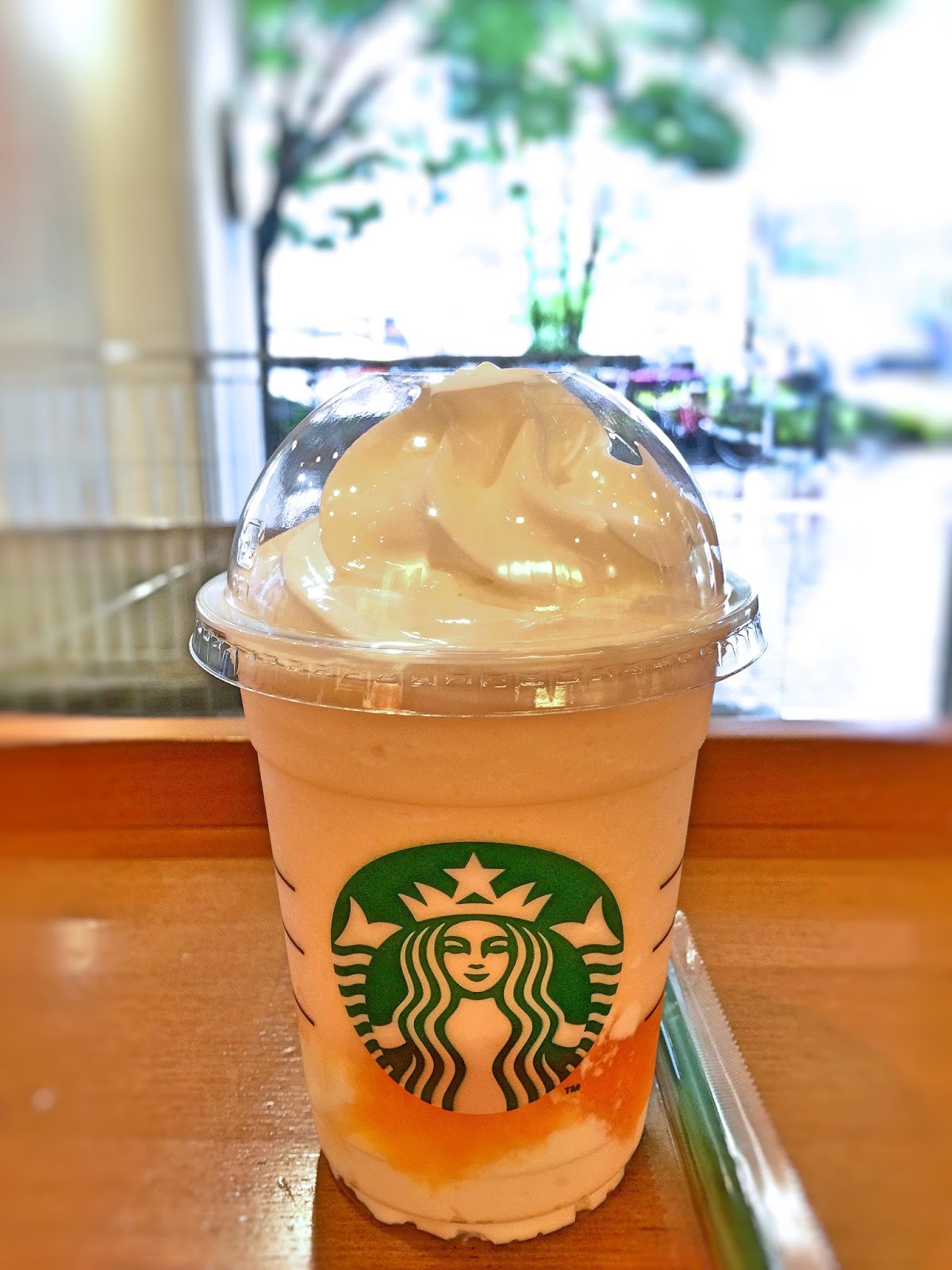


Ok, I'm getting to the end of my post. But first, onto Starbucks. I have to admit, I first started popping into Starbucks in Japan because I wasn't getting my coffee fix all the time. By the way, Japan's great for teas, but it's hard to find a good cup of coffee. And Starbucks isn't exactly great with the coffee either.
 
But anyway, that's how I found out that Starbucks Japan does seasonal stuff too! Spring 2 years ago, I tried a Sakura drink. This time round, its Cantaloupe melons for summer. I didn't get around to the other brownie matcha one. They were also advertising that a strawberry option was the next offering coming up. So if you're thirsty and you spy a Starbucks nearby, no harm popping in to see what they have on offer.


Now this is something that I don't always enjoy, but always receive requests from friends for. Japanese crackers. Japanese crackers can be in the form of rice crackers (on the left in my picture above) or the biscuit-like types (on the right in the picture above). So far, I tend to prefer the latter and my favourites rice crackers are the ones from Kitakaro in Otaru, Hokkaido.
 
Usually, when purchasing crackers, most stalls would have samples out for you to try. You can then make your choice based on your favourites. Like I said, I'm not a fan but my friends seem to love them quite a bit, so it's here too on the blog.


Next on the post (which is becoming extremely lengthy), are my bakeries and pastry shops. I love to visit these in Japan. The breads are soft and the Japanese often experiment with fillings. Mentaiko bread? Give it to me. Garlic sesame buns? Yums in the tums! And their cheese breads or cheese pies or cheesecakes? Oh lord. It's melt-in-your-mouth cheese heaven.
 
Of course, likewise, there are famous ones in different areas. Just do your homework before you go to find out. But I've also learnt to rely on my sense of smell and the sight of queues.


I'm finally coming to the end. These here (ok, the ones that I'm writing about) are what I call my buy-at-the-airport goodies. Simply because, they can always be found at the airports. Let's start with the photo above:
 
Top row from the left, are 2 boxes from Potato Farm. The first box is something new that Potato Farm put out while the 2nd box is what I traditionally would always get. There's always a limit placed on the number of boxes of Potato Farm that each visitor is allowed to purchase and it varies from place to place. I been told that I can get anywhere from 2 to 5 boxes in various places and airports. Now that in itself, should give you an indication as to how popular this awesome box of potato sticks is. They're good.
 
3rd box from left, top row: Tokyo Banana.
Do I need to introduce this anymore? Its famous. Again not a personal favourite of mine, but I know of many (and I do mean MANY) who seem to love this banana-cream filled sponge cake. By the way, there are variations now when it comes to Tokyo Banana, e.g. caramel-banana cream, etc. I've been told too that there's even a sakura one for spring!
 
Box below Tokyo Banana: The Strawberry Cake from Ginza.
My mom has resorted to calling this Tokyo Strawberry (after Tokyo Banana). Firstly, the name The Strawberry Cake from Ginza is just simply too long a mouthful. Secondly, it's almost like Tokyo Banana, except it's strawberry filled. I actually prefer this to Tokyo Banana. Less sweet.
 
Ignore the others in the photo. They're just random stuff I picked up for friends.


Here's a picture of how "Tokyo Strawberry" looks like. You'll have to give the Japs points for packaging, they're really good at stuff like that.


And here's what an individual pack of Potato Farm looks like. My 2 boxes were gone in less than a week.


Now, the next thing to watch out for in the Japan airports are the wonderful Royce chocolates. Seriously yummy chocolates. They've also got liquor filled ones but my favourites are the darks. So sinfully awesome. And they even have chocolate coated potato chips and popcorn. I bought the chips this time. Love the white chocolate ones much more though.


And finally, the last thing that I can recall to put into this post. Hori melon jellies. Ok, I know I wrote about jellies already. But these ones can be easily found at most airports. So if you don't have the opportunity to visit supermarkets or convenience stores, you'll know that there's this option at the airports as a last resort.
 
Except I still find the others nicer. These Hori Melon jellies are good, but the ones at the supermarkets and convenience stores are sometimes nicer.
 
All right. I hope this post helps those going to Japan soon, especially if it's going to be your first time there. Enjoy yourself snacking on these Japan goodies! Just don't blame me for the weight you put on k!


When in Japan, grab those Pocky and Kit Kats!

Sunday, 29 May 2016

I just returned from yet another trip to Japan last week. This time, we toured parts of Kyushu. Yup, the recently-hit-by-earthquakes Kyushu.
I had to make some last minute changes to the itinerary as a result. While I didn't fully enjoy myself, it was not because of the earthquakes and the resulting itinerary changes.
 
Instead, I was a sick cat during my entire 9 days in Kyushu. It really didn't help when we were caught in the rain on the first 2 days of our trip as well. In fact, I'm still recovering now and on my 3rd round of medications. Yeah, incredible right? 3rd round because I came back and got hit again by the flu superbug. (Hello immunity? What's up with you?)
 
Anyway, this time around, because I wasn't always feeling great, I really wasn't always in the mood to grab pictures. Even then, that's close to 2000 pictures. Just that in some places, the camera was stowed away. I'll share whatever I have (edited) still.
Yup, you've got it! Posts on Kyushu coming right up soon! Well, as soon as I sort through and edit whatever photos I've gotten. And mark my words, I'll be back for Kyushu again.
 
But for today's post, I'm just going to write about snacking in Japan. Haha. Yes, you read me right. Snacking in Japan deserves it's own post. Afterall, it's the land of amazing Pocky and Kit Kat flavours! And since I already brought up Pocky and Kit Kat, let's start with that first.

If you are not aware by now, Japan has an incredible number of flavours when it comes to Pocky and Kit Kat.


The chocolate and strawberry Pocky flavours that are easily available in Singapore, are also common in Japan. However, that's not what I'd get when I'm in Japan. There are several other flavours which are less common in Singapore such as milk, green tea/matcha and even cookies and cream. You'd probably be able to find some of these now in select supermarkets and convenience stores in Singapore. But during my initial trips to Japan, I used chow down regularly on their almond crush Pocky since it was much cheaper there in Japan than in Singapore.

However, nowadays I'll always be on the look out for the seasonal flavours that Pocky puts out. Pocky Japan puts out special flavours for each of the four seasons, spring, summer, autumn and winter. This round, we found out that the summer offerings were already on the shelves; chocolate-coconut and Brazilian orange.

The chocolate-coconut was the same as last year's and my mom is a huge fan of their summer chocolate-coconut flavour. You probably can't tell from my picture above, but that's a shot of a stacked 3 by 5 packs of chocolate-coconut Pocky. Yup, my mom hauled home 15 packs of those for her own personal consumption this round. I honestly think she would have bought more if she wasn't worried about the lack of luggage space.

The Brazilian orange offering though is an obvious marketing tie-in with the upcoming 2016 Rio Olympic Games. If you're headed to Japan now or soon, make sure you try this limited edition flavour. It combines (artificial) orange with chocolate. I have to admit, I didn't really like the first few taste, but the more sticks I bit into, the more addicted I got. It was the artificial orange that made it a bit weird at first, but I liked it well enough that I bought home 6 packs.

Yup, if you can't tell by now, my mom and I are huge fans of the chocolate-coated stick.


Ok, those of you who aren't headed to Japan now but in the near/distant future, you might wonder how to tell whether the packet you're holding is a seasonal offering or a limited edition flavour. The trick lies in looking for 4 Chinese characters. With these Pocky packs, it's usually on the top right hand corner of the box. I've circled it in blue in the photo above for your easy reference.

Now, let me help you decipher those 4 characters.
The 2 characters in the bottom row, 限定 (pronounced as xian ding) refers to it being a limited edition.
In the top row, the character on the right, 季 (pronounced as ji) is translated directly as season.
So the first character (top row, left) would then indicate which season it is:
春 - pronounced as chun, refers to spring

夏 - pronounced as xia, refers to summer

秋 - pronounced as qiu, refers to autumn

冬 - pronounced as dong, refers to winter.

Last year, we tried the Pocky summer offering (夏季限定) in Silicia Lemon, and that was pretty awesome too!

These Pocky packs usually retail at under 200 yen per pack, between 130 to 170 yen. I tend to pick them up whenever I dropped by any of their convenience stores (Lawsons, Family Mart or 7-11).


If that isn't confusing enough for those of you not familiar with these Chinese characters, Glico Japan (that's the company behind Pocky) also churns out these Giant Pocky sticks. Likewise, there's the common chocolates one, and then there's the special flavoured ones. This time round, the flavours are limited by areas, e.g. Kyushu region, Kyoto region, etc.

Again, how do you tell? If you take a look at the yellow Giant Pocky box in my photo above, I've again circled the characters in blue that you'll need to watch for. You'll see that there's 8 characters now, but its still 4 that you really need to understand:
Again, 限定 (xian ding) appears on the second row to denote that it is limited.

Now in the first row, 地区 (last 2 characters on first row, and pronounced as di qu) refers to area / region.
So whatever characters that come before it merely refers to the Chinese name of the area / region. In this case, 九州 (pronounced as jiu zhou) refers to Kyushu.

So, that yellow box of Giant Pocky I picked up is a Kyushu regional special flavour called Hiyoko Manju. The sticks are coated with chocolate flavoured with lima beans.
I honestly didn't know it was lima beans until I came back and googled. It tastes much better than what "chocolate flavoured with lima beans" would otherwise have evoked.

Each box of Giant Pocky usually contains between 16 to 18 individually wrapped giant sticks. They're pretty good to distribute out as gifts too.

By the way, Pretz also comes under the Glico company. No surprise then that it follows Pocky with their seasonal and regional flavours. That box of Giant Pretz is mentaiko flavoured. Mentaiko's a specialty in this region. I didn't expect to like the mentaiko Pretz so much though. Absolutely regrets just getting 1 box.

The smaller boxes of Pretz you see at the side are ramen flavoured. Now I gave away those and only kept a box for myself. I haven't gotten around to it yet though, so I'm clueless as to how it tastes like.

Now these regional specialities are less commonly found in convenience stores. Instead, I tend to pick them up at the gift stores or snack shops along major tourist attractions. Sometimes, these boxes are openly displayed such that it's hard to miss them. However, I've also noted that at times, they can be hidden in inconspicuous corners. The sort where you'll have to keep  your eyes peeled for them.


Now there's also Baton d'or, or what I personally term as expensive Pocky. (Had to crop them out of a photo, otherwise you might miss them). Now these are a class act. If you are a fan of Pocky, you'll definitely have to give this a try. The biscuit stick's yummier and I really enjoy the intense flavours of these Batons.

Let's just say that they're really good and I'll happily fork out the 500 yen (if memory serves me well) again for another box anytime.

Where to find them? You'll need to google for store locations, but Baton d'or stores are often found in those major departmental stores. You know, those huge departmental stores where the basement is a huge supermarket-and-food-store-galore? Yup, those types. I bought mine this time at the food basement of JR Hakata City, a huge mall in Fukuoka.

Gosh. This is proving to be a long post and I've only just gotten around to the Kit Kats. I think I'm going to break the snacking up into different posts!


Kit Kat also has flavours that are unique to Japan. In fact, I read somewhere that there's been more than 200 flavours that's been put out for Kit Kats! Milk chocolate, white chocolate, dark chocolate Kit Kats are now common in many Singapore supermarkets, etc. Even green tea/matcha Kit Kats are now becoming more easily available too. So please, don't waste time with these in Japan. Again, these are not the ones that you should be watching out for when in Japan.

Instead, check out their strawberry, strawberry cheesecake (shown in my picture above), sakura matcha flavours. Personally, I believe that these 3 flavours I've just listed appear to be the more common (read: easy to get) Japanese Kit Kat flavours. I've seen them pretty often at the shops at the Japan airports. Pretty easy to just grab them just before your flight home. I get requests for the strawberry Kit Kats pretty often if that's any indication of how yummy they are.


What's more difficult to locate are the regional specialties. Yup, Kit Kat flavours unique to a particular region. These are easily identified as Nestle kindly states them in English, e.g. Kyushu Edition, Kyoto Edition, Yokohama Edition. Otherwise, just look out for those circular stamps on the boxes. Or you can always google before you go as to what the regional specialty is. Yup, Google's your best friend!

Of course, if you see the 2 Chinese characters 限定 anywhere on the box, that usually also indicates that it is a limited edition.
In fact, anytime you see the characters 限定 or 期间限定 (pronounced as qi jian xian ding, and refers to a time limit), you know you have something that's limited edition on your hands. Trust me, Japan is the land of all limited edition flavours, from instant noodles, to potato chips, to (yeah) Kit Kats.

These regional Kit Kats are not always easy to find though. Again, your best bet to get them are at the gift shops and/or snack stores, especially those near major tourist attractions. The next best place would be at the airports but I've always had better luck with the stores near the attractions.  Likewise, they can be openly displayed or hidden in some corner. Just keep your eyes peeled.
In Kyoto, when I visited the Kiyomizu-Dera Temple, the shopping street was just lined with snacks stores selling these Pockys and Kit Kats. No way you could miss them and I could even do a little bit of price comparison between stores!

A word of advice though, when you see them, grab them. Like I said, they're not always easy to find. My first time in Japan, I thought I'll come by the Tokyo edition Rum and Raisin again and failed to pick up that box when I first spied it. Ever since then, I've yet to lay eyes on another box of Rum and Raisin Kit Kat. It's the one flavour that's been bugging me for a long, long time now.

This time round, what I've managed to find are the Beni Imo (left in the photo above) and the Amaou Strawberry (obviously, the right one then in the photo above) flavours.
The Beni Imo flavour (also known as the purple sweet potato Kit Kat) is an Okinawa and Kyushu regional specialty. This one is seriously yummy. It's probably one of my favourite Kit Kat flavours and I've tried quite a few already.

In case you get confused, there's quite a few regional strawberry flavoured Kit Kat. The Amaou Strawberry one just happens to hail from Kyushu. This is another one which I haven't gotten around to getting it into the tummy. I can't tell you much about it yet but I doubt you can go too far off with strawberry.

Phew! An entire post dedicated to Pocky and Kit Kat. Wow. Never knew I could write that much about Pocky and Kit Kat. I had intended to include other stuff but I'm seriously too tired to continue. Please. Flu meds knock me out. It's pretty darn good that I've lasted this long (just close an eye to any grammatical or spelling errors k).  I'll get around to sharing what other good snacks to have while in Japan in the next post!


Hokkaido Chitose Airport

Sunday, 8 May 2016

Ok, here's a quick one as to what I consider some of the more awesome stuff at Chitose Airport. Yeah, I'm a little rushed for time but figured if I don't get this out today, I'll be really swamped over the next week and I definitely won't be able to write anything then
 
So anyway, there's plenty of things to do at Chitose Airport. It's one of those airports where I wouldn't mind getting to earlier to walk around, eat and shop. It almost feels like a giant shopping mall.
 
Of course, those of you who need to stock up or grab last minute gifts, Chitose Airport has loads of stuff. I usually try to avoid getting those at the airport though, since stuff like your Japanese snacks are often marked up at the airports. But the option is definitely there if you need to grab those.
 
At Chitose Airport, there are 2 food stops that I would recommend:


Cheese tarts.
There are a few brands at the Chitose Airport actually. However, there is only one where you can smell the tarts from corridors away. And it's the only one where I've seen queues. Seriously, just follow your nose and the queue.
 
Do note, the picture above is not the one that I've mentioned, but something that I wanted to try another time from Le Tao (which is pretty famous and from Otaru). I forget to get a picture of the actual store while I was there. I secretly think that the aroma of the cheese tarts just made me forget everything.


Buta Don.
Ok, this time, the picture is the actual store, and this is one of the best buta don I have ever eaten. It was recommended to me by a friend. I brought my parents this round, and since then, my mom has been hankering for a second taste of it.


There's also a Daiso (aka the 100 yen store) in Chitose Airport. To be honest, Daiso can be found all over Japan. In all my other Japan trips, I would always make it a point to visit at least one outlet every trip. Unfortunately, because we were on a group tour this round, I actually didn't get to visit any while on tour! So you can imagine how happy I was that there's one at the airport. Even though it was a small one, at the very least, I didn't have to break that record.


Fans of Calbee, don't miss out the Calbee showroom on the 4th floor of the Chitose Airport. Ok, even if you are not a fan, give it a try. I very much prefer the Calbee snacks in Japan and oftentimes, they have seasonal flavours that can hardly be found outside of Japan.
 
There's also a Calbee Plus on the west side of the airport, 2nd floor where you can get those yummy, lip-smacking good potato crisps fresh off the fryer! You can even add toppings like chocolate! Trust me, they're good.
 
There are many other cool places to visit at the Chitose Airport (and I plan to visit those the next time I'm there). For those with kids, you shouldn't miss out the Doraemon Waku Waku Sky Park on the 3rd floor of the airport. There's something for everyone in the family, from kids' play area, craft workshops, gift shops and even a café.
 
There's also a Royce Chocolate World at the Airport. Royce is one of my favourite Japanese chocolate brand. Everytime I come back from Japan, my mom despairs at the number of boxes of Royce chocolates I haul home. Despair? Because it's yummy but it triggers her migraine.
 
So those of you headed to Hokkaido Chitose Airport soon, do make sure you have some time to explore that mega shopping mall of an airport!
 
 
Tourist Information
 
Chitose Airport

Dynasty Travels: 8D6N Colourful Hokkaido Tour, Last of Day 7 + Day 8

Sunday, 24 April 2016

If you had seen my last post, you would have realised that I missed out the last bit of Day 7's itinerary. Well, that was deliberate. Since we had the opportunity to visit an additional outlet mall just prior departure, I thought I'll combine both into a single post.
 
 
Day 7's itinerary:
Central Wholesale Market --> Ishiya White Chocolate Factory  --> Asahi Beer Factory  --> Mitsui Factory Outlet
 
Day 8's itinerary:
Rera Outlet Mall --> Chitose Airport


Yup. Unfortunately, that's about the only picture I took of the Mitsui Outlet Mall. Let's just say that I was hit hard by the shopping bug and forgot all about everything else.


At least, while at Rera Outlet Mall, I snapped a couple more with the mobile phone. Heh. By then, I had one round of shopping at Mitsui, so I guess the shopping bug was tamed a bit.
 
So anyway, one of the reason for combining the outlet malls into a post: There's really only so much you can write about malls and shopping. Besides, the brands I like or buy from, may not be what you as a reader would be interested in.
But really, the main reason is because my strategy for overseas (ok, maybe just limited to Japan)outlet shopping  is pretty much similar not matter where I go, and I thought I'll write about that in this post.
 
 
So, once you know which outlet mall you're headed for in Hokkaido, the very first thing you should be doing as part of your homework, is to go and google for the mall's website. The website is a treasure trove of information and here's what you should be looking out for to facilitate your shopping spree:
 
1) Directory of brands / shops available at the outlet mall, and where they are located in the mall.
This is especially useful if you have only a limited time allocated for shopping. Once you know which brands are available, you can prioritize which shops you want to head to first, which ones you would like to spend more time in.
 
As the Mitsui Outlet Mall was super huge and had 2 towers, you can imagine how important it was for us to know what we wanted to buy in the 2 hours that was given to us. Yup, 2 hours. Man... I'm telling you, I could easily spend an entire day in there,
I printed out a map of the Mitsui Outlet Mall prior departure as a backup but you can always pick up a map from both malls when you get there.
 
2) Occasionally, the websites features special events, promotions and even discount codes. Well, like I said, good to check things out before you go. You'll never know which coupons or codes might come in handy.


Once at the outlet malls, ask your tour guide or head to the reception/information counter for the coupon booklet, like the one in my photo above. This is common at the outlet malls. The coupon booklet lets you know which are the participating outlets and the conditions for use of these discount coupons. Once you have these on hand, SHOP ON! The savings from these coupons can be quite substantial when added up!
 
For those who enjoy shopping and shopaholics, my advice is to set aside at least a few hours or half a day at the outlet malls. If you do not have the luxury of time, then too bad, it's got to be a "divide and conquer" strategy. Both malls have food courts within their premises (and the food is way better than our Japanese stalls in Kopitiam) so you can also settle one of your meals before or after your shopping.
 
For those who enjoy supermarket shopping when overseas (one of my favourite thing to do when on a trip), you will be pleased to find out that the supermarket within Mitsui Outlet Mall stocks up on local farm produce as well!
 
Both outlet malls had free wifi available as well as coin lockers in case you need to store your stuff while you shop. They also accept all major credit cards so no worries there. Hmmm... or maybe you should lock your cards away.
 
My parents and I had a great time shopping. My mom hauled back a Coach bag and wallet while I got myself a Fossil bag (on an awesome bargain) which has since become one of my favourite work bags. We also bought some clothes from Gap, and sandals from Hush Puppies. My dad had wanted a pair of shoes from Hush Puppies too but they were out of his size. We also bought back sports wear from Addidas and Nike for the brother back home. But I was supremely disappointed to find out that the G-Shock and Baby G watches were at about the same prices when compared to Singapore! I also didn't have enough time to try on the Levis. Otherwise, it was a really great haul considering we only had 2 hours in Mitsui Outlet and another hour and a half at Rera Outlet. And that's including meals at both malls too!
 
An additional note:
Rera Outlet is really close to Chitose Airport. There's even a shuttle bus to and fro the airport and mall, so you can include it into your itinerary immediately after arrival or just before departure. Well, just make sure you have the time and energy. I personally know of a friend who visits Hokkaido pretty regularly. She and her family would hit Rera Outlet immediately after arrival just to get additional winter gear (at way cheaper prices than Sg) for their trip. A pretty good idea for the future winter Hokkaido trip I'm planning myself. Just make sure you already have the basics so you won't freeze getting there to Rera!
 
 
Tourist Information:
 
Mitsui Outlet Mall
Address: 3-7-6 Omagari Saiwai-cho, Kitahiroshima City, Hokkaido
DID: 011-377-3200
Opening Hours: 10 am to 8 pm. Restaurants and the food court close an hour later at 9 pm, but the last order timing would vary according to shops.
Check the website for days when the mall would be closed.
 
Rera Outlet Mall
Address: 066-8765 1-2-1, Kashiwadaiminami, Chitose-shi, Hokkaido
DID: 0123-42-3000
Opening Hours: 10 am to 8 pm. Some restaurants open at 11 am. Mall's opening hours may also vary with season.
Otherwise it is open all year round.
 

Dynasty Travels: 8D6N Colourful Hokkaido Tour, Day 7 (Part 2)

Sunday, 17 April 2016

Here's the unfortunate thing. It would appear that as days (while on tour) went by, the number of photos that I took, got lesser and lesser. By the time I hit Day 7, let's just say I had major camera fatigue. Also, Day 7 was the one day in our entire Hokkaido trip where it rained. Gloomy skies and rain, hence the reluctance to also bring the camera out. Although, having said that, we were indoors for most of Day 7. Yup, it was just an excuse.
 
No matter what it was, the lack of photos obviously does not bode well for a blogger. We'll get by for the next couple of posts, but I seriously have got to remember to keep taking photos on the next trip!
 
Day 7's itinerary in reality:
Central Wholesale Market --> Ishiya White Chocolate Factory (白い恋人パーク) --> Asahi Beer Factory ( アサヒビール北海道工場) --> Mitsui Factory Outlet
 
I kind of feel that this next tourist stop on the itinerary won't need much introduction from me. Anyone who had visited Hokkaido (or any part of Japan I think) would have heard/bought or had friends request a box of the famous Shiroi Koibito chocolate cookies. Yup, it's that famous "two thin butter cookies with that layer of chocolate sandwiched in-between". The one that comes in a pale blue metal tin. This famous confectionery is not a particular favourite of mine or my family's, but I know of scores of friends and colleagues who are fans of the chocolate biscuit.
 
In fact, this particular confectionery is so famous, visiting the theme park would seem like a must in most tour group itineraries. Even those on free and easy tours would have made this one of their pit stops. So based on that, what you can expect at the Shiroi Koibito theme park (aka the Ishiya White Chocolate Factory)? Crowds. Crowds and crowds of tourists.
 
Having said that and as someone who absolutely hates crowds, I have to say, it was still pretty enjoyable. But don't say I didn't warn you.


At the entrance of the theme park, you will be presented with a "passport" as well as a token Shiroi Koibito cookie. I found the passport quite useless actually since everything was in Japanese, but the pictures inside would give you an idea what to expect while in the theme park.


Those of you who enjoy workshops would be glad to know that there is a cookie-making workshop at the Ishiya White Chocolate Factory. Ok, it was more like a cookie-decorating workshop. After you don their hygiene gear (you know, plastic aprons, hats, foot-wear and the works), they will shuffle you to the work tables where each individual has a Hokkaido-shaped cookie to decorate. You'll be given a box at the end to store your cookie and it'll even last the flight home! Ours came out of our luggage unscathed. But I suspect that's really because of my superior packing skills.
 
I also think this would be great as one of those parent-child bonding activities to do while on holiday. That is, if you're one for such workshops. While my parents and I participated, to be honest, I just wanted to be out of their hygiene gear asap, and instead tour the grounds and get to the food.
Yup, that's me and my parents. We prefer sights, landscapes and food.


While in the building, there are a lot of exhibits on various floors, including cake decorations, toys and even kitchen ware. Apparently the Meissen cup and saucer above was one of the most expensive exhibits around. The exhibits were kind of weird though. Apart from the cake decorations that could still fit into the overall theme, I didn't think that I'll find toys and gramophones around in a chocolate factory.


What did make sense to us, was this display of Japanese efficiency. My parents and I actually stood at the windows watching the industrious workers sort, pack and monitor the production of the famous confectionary. The only reason why I chased us off? Limited time and I wanted to get to the café, theme park grounds and souvenir shop.


Now the photo above was me being greedy and only remembering to snap a picture after a mouthful. Okay, it might have been a few mouthfuls. I honestly cannot remember. What I do remember was that the soft serve was awesome. Even in the cold, rainy weather.


And since I forgot to grab photos of the café and souvenir shop, let me just grab some pictures off the "passport" and share with you what you should be focusing on.
 
On the bottom right (picture above), you can actually get customised souvenirs. It's basically one of those "take your touristy photo and I'll print it on the container" thing. Of course it'll cost you though. So unless you're looking for a special photo keepsake, you can probably skip this. Especially if you are on a budget.


Those of you foodies, please note. The soft serve comes in 3 types, chocolate, white chocolate and a mixed version.
A tip: The white chocolate version is actually the same type that goes into the white chocolate cookies. You can go for the mixed if you want to try both. I always preferred the white chocolate in the cookies, I just went for the full white. No regrets.
 
What's less well-known (but I personally find yummier) is their canned chocolate drink. That's the one bottom of the photo above. There is a café at the top floor of the building that serves cakes and this special chocolate drink. If you have the time and opportunity, please do enjoy the chocolate drink. Let me know how the cakes fare though.
 
However, if you're like me, short on time and opportunities, grab a few cans of the chocolate drinks to go. This is seriously one of the best canned chocolate drink I've had. Rich and good. I've also seen it around some of the convenience stores in Hokkaido, but it doesn't always seem readily available. I couldn't get enough of them during my time there.
 
Another tip if you're shopping at the souvenir store. Many people just aim for the standard box of Shiroi Koibito cookies. First, if you have a tour guide, ask if they will be bringing you somewhere else where you might be able to get them cheaper. Some of the shopping streets have such stores and they are oftentimes cheaper. In addition, these stores carry other snacks/souvenirs and some even offer you boxes to pack them all up neatly. Especially if you buy quite a bit. That makes your subsequent luggage-packing a lot easier. If you don't have a tour guide, do a bit of online homework. It's not difficult to locate such stores.
 
However, what you should be purchasing at the souvenir shop at the Ishiya White Chocolate Factory are the non-standard items. That basically refers to anything else that is not the famous white chocolate/chocolate cookies that come in that pale blue tins. The stores that I mentioned in the paragraph above, tend to carry only the more well-known Japanese snacks. Makes sense for them to do so actually.
 
Of course, if you're not certain that you'll being able to hit those stores that I mentioned, then please by all means, make sure you get your share of the Shiroi Koibito cookies. I wouldn't want to be accused of making you lose your precious cargo of famous chocolate cookies.
 
What I am saying though is while at the souvenir shop, do take a look at the other items that are being offered by Ishiya. These are the ones that may not be readily available elsewhere. If you're not certain which ones are good (and honestly, I've forgotten which ones myself), get the assortment pack. I find the assortment pack a pretty good way to try almost everything they have to offer. Plus, they're pretty good to share around with the family and everyone gets to try everything as well!


Of course, by the time my parents and I finished our soft serves and purchased our Ishiya snacks, we had only a few minutes left to tour the grounds. Sigh. As usual. The lack of time.
 
What I can tell with you based on initial impressions amidst a gloomy, rainy weather, was that the kids would probably enjoy this place. There were train rides, a tree house and what looked like a playground. For the adults, there's a rose garden, which probably means Instagram-worthy pictures are likely aplenty.
 
Unfortunately, those were the only few photos I managed to grab before we were ushered back up on the tour bus.


Next stop, the Asahi Beer Factory. There are a few beer factories/distilleries that conduct tours, including Nikka and Suntory. It depends on what's available on the tour package or where and when you're headed if you're going on your own.


While at the Asahi Beer Factory, we were told that photos were not allowed in some parts. The tour itself was quite educational and brings you through the process of making those beers. In fact, it was then I learnt that hops was actually quite an important ingredient of the beer-making process! (And just a couple of weeks back, I read somewhere that there was a shortage in the hops harvests this year! Hopefully that doesn't affect the breweries!)
 
At the end of the tour, visitors will be treated to (up to) 3 glasses of Asahi beer. My dad had some and he found it pretty good, especially since he went for the best pour. However, as my mom (who's allergic) and I don't drink beer (I do take alcohol, just not beer), we were treated to their drink products. My mom opted for the apple juice which was quite sweet. For me, it was a no-brainer. I just asked for my all time favourite - a Calpis.


What fascinated me was that Asahi produces many other products, including one of my all time favourites - the Calpis series of drinks and candies! While I don't drink beer, whenever I am in Japan, I become a Calpis-aholic. Friends who travelled with me to Japan and my parents have since learnt to just buy me the Calpis drinks or the Japanese yogurt/yakult drinks whenever they are at the convenience stores.
 
There are even seasonal Calpis products that I always look out for whenever I head to Japan. I got the candy packet in the picture above at the Asahi Beer Factory itself. This was the hard candy version and had an additional cherry flavour as the seasonal flavour. While I couldn't find them on this particular Hokkaido trip, I actually prefer the Calpis gummies though. I usually buy the Calpis gummies whenever I hit the Daiso stores in Japan. Other things available at the Asahi Beer Factory include their beer jelly chocolate, beer cakes that come in pretty barrels, etc.
 
Well, if you ever head to Japan and happen to come across Calpis, just try one and let me know if you'll like it!


Dynasty Travels: 8D6N Colourful Hokkaido Tour, Day 7 (Part 1)

Wednesday, 6 April 2016

Today's post is going to be a pretty short one actually. For one, I'm tied up helping my friend prepare props for her upcoming bunny photo shoot. Yup, she has several rabbits and she gets professional studio shots done for them! How amazing is that! But before I digress, another reason is also because I've been busy doing my "homework" for another trip! Hurray (for me)!

So anyway, back to this Hokkaido series, thank goodness I'm finally on Day 7. I really hope (or maybe more like have to) finish this series before the next trip!

By the time we got to Day 7, the official itinerary given by Dynasty Travels is almost moot:
Central Wholesale Market --> Hokkaido Shrine (done on Day 6) + Maruyama Park (park next to Hokkaido Shrine which we completely skipped!) --> Odori Park (done of Day 6 which obviously did not register much on me) --> Asahi Beer Factory --> Tokeidai (that's the clock tower done on Day 6) --> Mitsui Factory Outlet.

See what I meant by moot?

Which means in reality, what we had left by Day 7  to cover:
Central Wholesale Market (札幌場外市場) --> Ishiya White Chocolate Factory --> Asahi Beer Factory --> Mitsui Factory Outlet.


Unfortunately, I think the itinerary is a little mis-leading. Where we actually visited (or where you would visit) was the Curb Market or Crab Market (depending on which website you read) that's next to the Central Wholesale Market. In reality, fresh produce is delivered daily to the Central Wholesale Market but then these are sold via bidding. Products are then made available at the Curb/Crab Market once the bidding ends, and that's what's open to the public. 

The Curb/Crab Market hence is really the 60+ shops that line the 2 sides of the street. What we found in abundance were vegetables (depending on what is in season) and seafood, especially crabs! No brain-er then why Crab market became a moniker.

Given that it's 60+ shops between 2 sides of a street, it's not that huge a place. So if you want to compare prices, it's not difficult to do so. 
However, I have to say this after experiencing Japan on several trips: the Japanese price their products according to quality. So in a way, you get what you pay for. They also take quite a lot of pride in the quality of their produce. Hence, I personally do not bother to do price comparisons and I'll just pay whatever they tell me. In fact, I've also had enough encounters where the stall owners would on their own accord, extend their hospitality in ways such as a drink or a freebie or even a recipe. Admittedly, less so in the more touristy places, but it still happened enough times for me to be mightily impressed.

Another interesting fact I came to learn, the best in Japan is oftentimes also not exported. While in the Curb/Crab market, it's actually a pretty common sight to see locals purchasing produce to be sent to someone else who might even be in another prefecture. However, they stop short of shipping their goods internationally. But that doesn't stop you from carrying them home in your own luggage! Of course, you have to check your own country's restrictions as to what can be brought in! I've seen people throw away food at customs just because they failed to do that. 

Another tip if you intend to bring produce home, put the Curb/Crab Market on the last/second last day of your trip if possible. You'll want to bring back the produce you bought as fresh as possible. Some items may not last the journey home if this was one of your initial stops on your vacation. 

So, on that note, let me just give you some tips as to what are the good stuff you can bring back with you. 
Disclaimer though, I traveled in July, so some produce might be seasonal.


If you like asparagus, you can get them easily at the Curb/Crab Market. I didn't bring them home this trip but the last time I did, they were seriously awesome. 

I didn't get a picture as I was too busy devouring samples, but melons are also great to bring home for the family, especially since Japan doesn't export the quality ones. You can let the stall owner know that you intend to carry them home on the aircraft, and he'll pack it up nicely for you. We brought 2 melons home with us (mostly for the brother who didn't come along this trip), and the melons survived the plane journey unscathed. 

However, please note that the melons can ripen very quickly, which was why I mentioned earlier, that you should time your visit to the market carefully. Let the stall owner know when your flight home is. He/she should then be able to help you pick the melons accordingly. The one where we purchased our melons from refused to sell his melons to some tourists who were flying home only a week later as the melons would have rotted by then. Instead, he cut them slices to eat, free of charge! 
Love that hospitality. Absolutely love it!


Another must-buy in my opinion: corn. My luggage was getting too heavy so we only bought a few ears but another family in my tour group bought an entire carton of them. Yup, you heard (read) me right. A carton of corn ears.

Get your hands on the albino ones (that's what I called those white ones). If you don't believe me, just get one first, eat them raw on the spot. Yes, you can and in fact should eat them raw. In my mother's and my opinions, they are absolutely wasted if cooked. The local tour guide Ms Reikko backed us up on that claim too. These albino corns are to-date, the sweetest corn I have ever tasted. It was so good that when we returned to Singapore, my mother just lamented about the lack of luggage weight. 

Don't just take my words for it, go try it yourself.


Like I said, crabs are plentiful here. Plus, they're huge-assed. Seriously plus-sized. Some were even bigger than both my hands put together. They'll probably taste super yummy (since I didn't have any, I can't say for sure), but I sure as hell wouldn't want to meet these monsters on the beach or in the sea ever. I'll just see them on the dinner table and that'll be great,


There are also restaurants in the market. So you can actually purchase your seafood and have them prepared by these restaurants. Some of these stalls were even slicing them crab legs up as sashimi. Yup, you can't get them any fresher than that!


Heh. And this picture is just so I can prove that there were other seafood available and not just crabs.
 
FREE BLOGGER TEMPLATE BY DESIGNER BLOGS